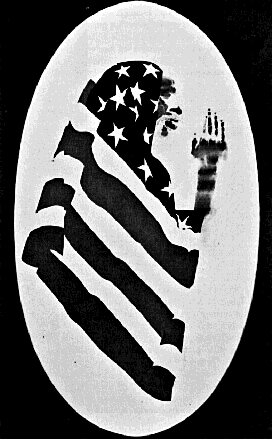
"Pray for America" (1969) by David Hammons

Lifting Voices in Prayer
Regional Culture History

Lesson 13


Hammon's works of art encompass a body-printing process fused with silk-screen painting. He places a smooth illustration on either the wall or the floor, depending upon how intense he wants the print to be. (Body prints made on the floor are darker). Then he coats himself all over with margarine--hair, body, and clothing, with the fabrics chosen for textural interest. Thus primed, the artist presses himself against the surface to be printed. Separating himself from the board, he then sifts fine powdered pigments all over the board, so that the areas covered with the margarine absorb the color, while the uncoated portions acquire a slight film of the same hue. Finally, additional forms are screen-printed in.

In "Pray for America" an elderly African American, draped in an American flag, is praying.

Exercise:


List certain developments that unfolded in 1969 and rocked the foundation of the United States, and explain why the figure in Hammons' painting might be praying for the future of this country

Write your response in the form below:

Your Name:

Your E-Mail Address:

Mail to:

Subject:

(L13Q1)

Your response:


Assignment:


Read Dr. King's "Letter from a Birmingham Jail".


Consideration:


Given the content and structure of "Letter from a Birmingham Jail," does it seem that Dr. King is launching an indictment or offering a prayer?

Is the indictment or prayer directed against someone (certain individuals among the general populace or particular government or religious officials; or something (an idea, policy...)?

Write an essay to clarify your position.

Write your response in the space below:


Assignment:


In Pray for America," an elderly African American is draped in an American flag. Conduct a search and produce statistics that speak to economic conditions (during the 1960's) relative to the elderly generally and African Americans in particular.


Assignment:


The *Southern Christian Leadership Conference, as an umbrella organization, confined modes of operation applicable to the civil rights movement of the 1950's and 1960's primarily in the South. In addition to concentration of so much civil rights activity in one region of the country, can you show that modes of operation aimed at agitation for civil rights was launched in other regions of the country? Who from what ethnic backgrounds in another part of the country wrote a respective manifesto comparable to King's letter from a "Birmingham Jail?" Write an essay that compares and contrasts King's point of view in his letter with point of view in a manifesto written by someone else.

Write your response in the space below:


a) How does the the jail serve as a symbol that frames King as author (a prisoner writing a letter)?

Write your response in the space below:

b) How does the jail serve as a symbol that frames the "Birmingham Letter" as object (should the populace respond positively to a letter written by someone who was incarcerated in jail)?

Write your response in the space below:

c) How does the flag draped around the elderly African American serve as a symbol that frames the prayer inherent in the title of Hammons' work?

Write your response in the space below:


Log on to the WebBoard


to discuss Regional culture history.


End of Lifting Voices in Prayer


Regional Culture History Selection List | Fact of Contact menu