|
Educating the Populace Regional Culture History Lesson 15
|
|
Educating the Populace Regional Culture History Lesson 15
|
|
Consideration:
|
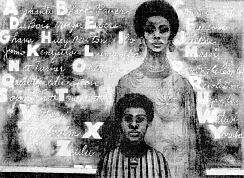
In addition to other images, certain words are written on the board in Cliff Joseph's painting, "Blackboard." |
|
Questions:
|
a) How does the lesson written on Joseph's "blackboard" speak to African American history and culture? Write your response in the form below: |
|
Your Name: |
|
|
Your E-Mail Address: |
|
|
Mail to: |
|
|
Subject: |
|
|
(L15Q1) Your response: |
b) Does the entire lesson or particular words on the blackboard convey impressions about the history of a particular region in the United States? Or impressions about the United States as a particular region in the world? Write your response in the space below:
|
|
Consideration:
|
|
|
Focus:
|
The Orleans Parish Courthouse is at the corner of Tulane and Broad Streets. A statement etched at the top of the building reads:This is a government of law, not of men.
|
|
Task: This is a research assignment.
|
b) Given the social climate in the country at the time the building was constructed, what type "instruction" did use of the building offer. For instance, the Orleans Parish Courthouse at Tulane and Broad Streets silently screams...This is a government of law, not of men.
|
|
|
l. When the courthouse was opened for business and the first trials were held there, could African Americans be tried in this country by a jury of their peers (other African Americans).
2. Once the courthouse was constructed and African Americans sought civil services, did they have to enter the building through doors marked "colored" while others entered doors marked "white?" Did they drink from water fountains with such designations? Did they utilize "colored" or "white" bathroom facilities?
3. If the courthouse building made use of tax monies collected from all citizens, but all citizens who utilized the building could not do so equitably, did the statement etched on the building equate to false instruction.
4. Given what you learn, would you say that the courthouse as "blackboard" is emblematic of the creed expressed, or a reversal of that creed which then might read...This is a government of men, not of law. |
|
Assignment:
|
Write your response in the space below:
|