|
Walking that Extra Mile Popular Culture History Lesson 2 Jimmie Mosley, Jr. painted "Protest" in watercolor and presented it at the Atlanta University annual in 1965. Watercolor encompasses the process of painting by means of colors mixed with water and some adhesive, as gum or size, instead of oil. The purpose of this lesson is to study how protest, as symbol and practical application, can be studied as a measure of popular culture.
|
|
Consideration:
|
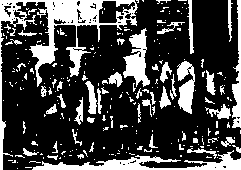
In January 1960 John Fitzgerald Kennedy was elected as the first Catholic President of the United States and announced his ideas for the nation under the platform The New Frontier. On February 1, 1960 Ezell Blair, Joseph McNeil, David Richmond and Franklin McClain, four African American students enrolled at North Carolina A & T College, sat down at the lunch counter in the F. W. Woolworth store in Greensboro, seeking to be served. Their activity launched the sit-in movement across the U.S. to dismantle segregation. At the University of Michigan students Tom Hayden and Al Haber formed the Students for a Democratic Society (SDS) in 1960. Freedom Rides began in May 1961. On May 14, a mob of whites attacked the black and white protesters and burned and bombed the bus they were riding. The Freedom Riders boarded another bus and went to Birmingham where they were brutally beaten.
|
|
Supporting information:
|
|
|
Assignment:
|
Focus on developments in U.S. society in the early 1960s to write an essay that weighs what in Kennedy's inaugural address seems not to offer enough hope and promise to young Americans so that protests took place around the country. What is your understanding of "protest" as a measure of popular culture? Write your response in the form below: |
|
Your Name: |
|
|
Your E-Mail Address: |
|
|
Mail to: |
|
|
Subject: |
|
|
(L2Q1) Your response: |
|
|
|
|