

D2L (the company that owns Brightspace) uses Continuous Delivery to update our Brightspace system. The Continuous Delivery model gives us regular monthly updates allowing for incremental and easily integrated changes with no downtime required for our Brightspace system.
Our Continuous Delivery update occurs on the 4th Thursday of each month. D2L provides release notes to help users stay up-to-date with the changes.
Here are some of the updates in the February 2026/20.26.02 release that were added to our system this month:
1) Assignments – Group assignments now supported in Advanced Assessment
Group assignments are now supported in Advanced Assessment, enabling instructors to collaboratively evaluate groups of learners in Brightspace using Co-Marking, Delegation, and Multi-Evaluator capabilities. This update leverages the existing Groups tool, allowing learners to submit work as a team and receive shared feedback and grades through Advanced Assessment.
The feature introduces the following key improvements:
- Seamless group evaluation: instructors can allocate evaluators to groups rather than individuals.
- Consistent experience: interface terminology and visuals have been updated to reflect group workflows:
- References to Learners are replaced with Groups, such as Allocate Evaluators to Groups.
- Evaluation and feedback panel text reflects group-based workflows.
- Improved workflow integrity: confirmation prompts prevent accidental evaluator setting loss when switching between group and individual assignments.
To enable group assignments, instructors must first create groups in Course Admin > Groups. Then, when creating an assignment, they must select Group Assignment under Submission & Completion.

To trigger the Advanced Assessment workflow, select evaluators in the Evaluation & Feedback dropdown.

The selected evaluators will be shown in the Evaluation & Feedback accordion where you can proceed to manage the group allocations.

Additionally, the following changes were made in the Manage Allocations table:
- New dropdown options are available to assign evaluators to groups.
- Group member names are displayed in a separate pop-out.


When sections are enabled, a Sections filter appears in the Manage Allocations dialog. Instructors in the selected section display a small tag under their names to indicate the applied filter, and only groups containing learners from the selected sections appear in the left-hand column.
When switching between individual and group assignments after evaluator allocations are made, existing allocations are removed. A confirmation prompt appears to alert users.
Notes:
- Group assignments in Advanced Assessment are only supported in the new assignment creation page. Legacy assignment creation page users should follow the prompt to the new page, to create group assignments in Advanced Assessment.
- Grades sync as before; individual overrides remain possible.
- Group assignments are not currently supported in Quick Eval.
- Switching between individual and group assignment types is disabled after learner submissions are made.
Previously, group assignments were not supported in Advanced Assessment. This update removes that limitation, enabling the use of Co-marking, Delegation, and Multi-evaluator features for groups.
2) Assignments – Improved error messages when uploading unsupported file types
Brightspace now provides clearer and more consistent error messages when learners attempt to submit file assignments using unsupported file types. These improvements help learners understand which file types are allowed and make it easier to correct submission issues.
The updated messaging appears across assignment submission workflows and Activity Display, ensuring learners receive appropriate guidance based on the context of their submission.
Updated error messages for file submissions
When a learner attempts to upload a file from Google Drive, One Drive or Locker with a restricted or unsupported file extension, Brightspace now displays more specific messages depending on the number of restricted file types configured for the assignment.
Assignment submission page
- If fewer than seven file types are restricted, learners see a message listing the allowed file extensions, such as:
- Your work could not be submitted. You can only submit files with the following file extensions: PDF, DOCX, or TXT.
- If seven or more file types are restricted, learners see a simplified message:
- Your work could not be submitted. You can only submit files with allowed file extensions.
For file assignments, learners can now also see the list of Allowed File Extensions. This list previously appeared only for File and Text assignments and is now available for File assignments as well.
Improved feedback in Activity Display
In Activity Display, learners now receive clearer visual indicators when uploaded files are not allowed:
- If a learner uploads files with unsupported extensions, Activity Display identifies which uploaded files are not allowed.
- If a file has no extension or the file type cannot be detected, Activity Display notifies the learner that the file type is unsupported.
- If five or more files with unsupported extensions are uploaded, Activity Display displays a consolidated message indicating that multiple files are not allowed.
Improved validation when configuring Custom File Types in Assignment Creation
When instructors set Allowable File Extensions to Custom File Types during assignment creation, Brightspace now requires at least one file extension to be entered before the assignment can be saved.
If the field is left blank, Brightspace displays a clear inline error message and prevents the assignment from being saved. This improvement helps instructors avoid invalid assignment configurations and reduces submission issues for learners.
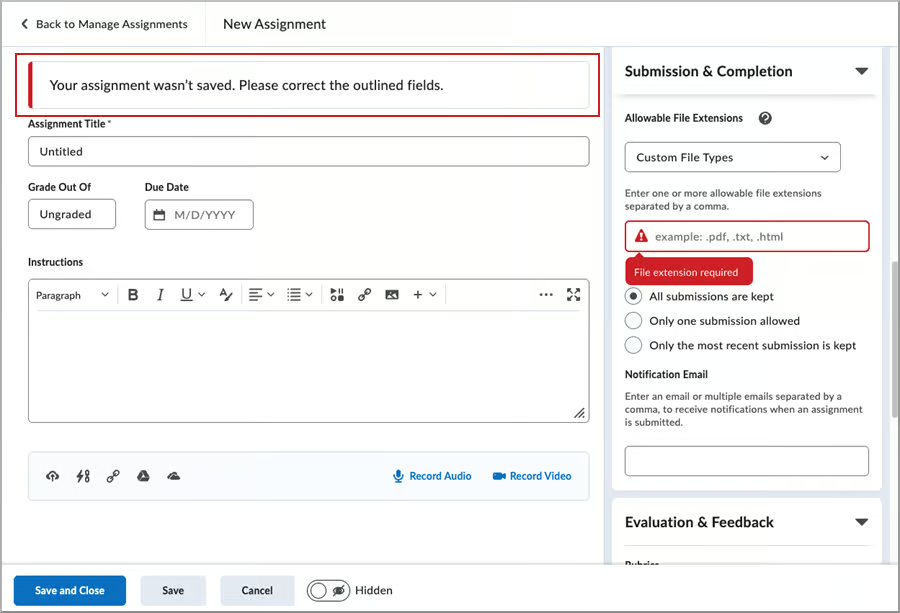
Note: These changes improve messaging only and do not alter which file types are allowed for an assignment.
3) Class Progress – User progress for Content charts now loads asynchronously
The completion progress bars for the Content Completed and Content Visited charts now load asynchronously as instructors scroll down the Class Progress page. Progress details appear for each user as they come into view, allowing the page to continue loading smoothly regardless of the number of users or content objects being calculated.
The d2l.Tools.ClassProgress.AsyncContentChartsCount (Org) configuration variable determines the threshold for the number of content objects that triggers content charts to load asynchronously. The default value is 50 content objects and can be increased to a maximum of 1,000.
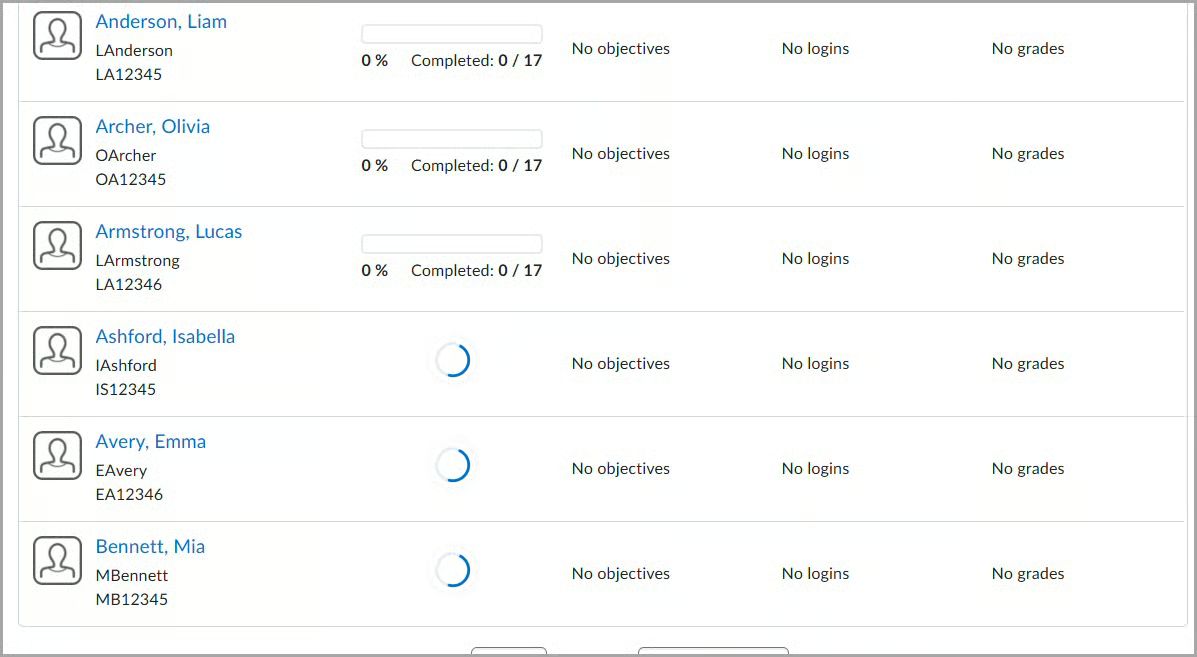
Previously, courses with a large number of users or content objects could experience page timeouts when viewing the Content Completed or Content Visited columns in Class Progress.
4) Grades – Improved navigation within the Enter Grades page
The Enter Grades page now offers improved horizontal navigation, making it easier to work with large gradebooks. Instead of relying on a horizontal scroll bar at the bottom of the page, instructors can use navigation arrows on either side of the gradebook, along with a scroll bar at the bottom of the grid, to navigate across grade columns.
This update also improves how dropdown menus behave, preventing them from appearing underneath other fields such as user names.

Previously, horizontal navigation relied on a scroll bar at the bottom of the page, which was not always visible unless users scrolled down.
If you are interested in getting more information about these and all the February Continuous Delivery updates, refer to the Brightspace Platform February 2026/20.26.02 Release Notes.
Additionally, refer to the Brightspace Release Notes for Continuous Delivery Releases, for details about current, past, and to preview upcoming continuous delivery updates.
Want more information?
View current, past, and preview upcoming Continuous Delivery release notes
Instructors Quick Start Tutorial
Brightspace Known Issues
Request a sandbox course
Sign-up for Brightspace training sessions
You can find Brightspace help at D2L's website.
Join the Brightspace Community.
Try these Brightspace How-To documents.
Visit our Brightspace FAQs for additional Brightspace information
or schedule a one-on-one session, email, or
call Janice Florent: (504) 520-7418.
Note: Are you doing something innovative in Brightspace or perhaps you've discovered a handy tip? Share how you are using Brightspace in your teaching and learning in The Orange Room.