D2L (the company that owns Brightspace) uses Continuous Delivery to update our Brightspace system. The Continuous Delivery model gives us regular monthly updates allowing for incremental and easily integrated changes with no downtime required for our Brightspace system.
Our Continuous Delivery update occurs on the 4th Thursday of each month. D2L provides release notes to help users stay up-to-date with the changes.
Here are some of the updates in the March 2026/20.26.03 release that were added to our system this month:
1) Awards – Longer text fields and preserved formatting for Badges and Certificates
o provide greater flexibility when creating Awards, instructors can now enter more detailed information in award text fields. This update increases character limits and preserves formatting, allowing clearer criteria, descriptions, and evidence to display consistently across Award views.
The following fields now support increased character limits:
Name (256 characters)
Description (512 characters)
Criteria (1000 characters)
Evidence (on issued award) (1000 characters)
Previously, text fields had lower character limits, which restricted context and detailed instructions. In addition, line breaks entered in these fields were not consistently preserved when Awards were displayed.
This feature implements the following PIE item:
D13138 – Awards description field
2) Classlist – export Classlist details to CSV and improved Print output
Instructors can now export Classlist details to CSV. The Export button enables full or partial user exports, mirroring Classlist view content for offline or administrative use.
Printed Classlists now include pronouns (if visible) and course identifiers, providing more complete context for in-person workflows and record keeping.
A new Export button appears on the Classlist page
This feature implements the following PIE items:
D9855 (Printing Classlist with pronouns)
D9391 (Classlist – allow export of pronouns)
D2124 (Export of Classlist)
D6948 (Classlist to Excel or CSV)
D2658 (Include course title with Classlist printout)
D9215 (Show course offering code on exported or printed Classlist)
D6667 (Classlist export)
3) Pulse – Engagement tracking improvements
This release improves the reliability, timeliness, and consistency of engagement tracking from Pulse. This enhancement ensures that engagement data more accurately reflects how learners are interacting with their courses across platforms.
Engagement related events in Pulse are now logged immediately. For example, when a learner taps on a course to open it, the Course Access details are sent to the database, the Last Accessed date in Classlist updates, and an Intelligent Agent that checks for course engagement knows not to notify the instructor. Downstream tools that report on learner engagement now represent both Web and Pulse activity equally.
Previously, Pulse events were sent asynchronously in batches, resulting in missing or late engagement tracking data and discrepancies between different tools.
Key improvements:
System Access Start events are sent immediately when the app is launched.
System Access Start events are decoupled from System Access End events.
When the app is in the background or idle, System Access End events are sent after 30 minutes of inactivity.
Course Access events are sent immediately when a user clicks into a course.
Note: Are you doing something innovative in Brightspace or perhaps you've discovered a handy tip? Share how you are using Brightspace in your teaching and learning in The Orange Room.
D2L (the company that owns Brightspace) uses Continuous Delivery to update our Brightspace system. The Continuous Delivery model gives us regular monthly updates allowing for incremental and easily integrated changes with no downtime required for our Brightspace system.
Our Continuous Delivery update occurs on the 4th Thursday of each month. D2L provides release notes to help users stay up-to-date with the changes.
Here are some of the updates in the February 2026/20.26.02 release that were added to our system this month:
1) Assignments – Group assignments now supported in Advanced Assessment
Group assignments are now supported in Advanced Assessment, enabling instructors to collaboratively evaluate groups of learners in Brightspace using Co-Marking, Delegation, and Multi-Evaluator capabilities. This update leverages the existing Groups tool, allowing learners to submit work as a team and receive shared feedback and grades through Advanced Assessment.
The feature introduces the following key improvements:
Seamless group evaluation: instructors can allocate evaluators to groups rather than individuals.
Consistent experience: interface terminology and visuals have been updated to reflect group workflows:
References to Learners are replaced with Groups, such as Allocate Evaluators to Groups.
Evaluation and feedback panel text reflects group-based workflows.
Improved workflow integrity: confirmation prompts prevent accidental evaluator setting loss when switching between group and individual assignments.
To enable group assignments, instructors must first create groups in Course Admin > Groups. Then, when creating an assignment, they must select Group Assignment under Submission & Completion.
Select Group Assignment under Assignment Type in the Submission & Completion settings to create a group-based assignment.
To trigger the Advanced Assessment workflow, select evaluators in the Evaluation & Feedback dropdown.
Click Select Evaluators under Evaluators in the Evaluation & Feedback settings to create an assignment.
The selected evaluators will be shown in the Evaluation & Feedback accordion where you can proceed to manage the group allocations.
Click Manage Allocations under Allocate Evaluators to Groups in the Evaluation & Feedback settings to review groups in the course and which evaluator will be assigned to evaluate each group.
Additionally, the following changes were made in the Manage Allocations table:
New dropdown options are available to assign evaluators to groups.
Group member names are displayed in a separate pop-out.
An example of group member names when viewed from the Manage Allocations dialog.Use the Manage Allocations dialog to set a default evaluator allocation method and adjust group assignments.
When sections are enabled, a Sections filter appears in the Manage Allocations dialog. Instructors in the selected section display a small tag under their names to indicate the applied filter, and only groups containing learners from the selected sections appear in the left-hand column.
When switching between individual and group assignments after evaluator allocations are made, existing allocations are removed. A confirmation prompt appears to alert users.
Notes:
Group assignments in Advanced Assessment are only supported in the new assignment creation page. Legacy assignment creation page users should follow the prompt to the new page, to create group assignments in Advanced Assessment.
Grades sync as before; individual overrides remain possible.
Group assignments are not currently supported in Quick Eval.
Switching between individual and group assignment types is disabled after learner submissions are made.
Previously, group assignments were not supported in Advanced Assessment. This update removes that limitation, enabling the use of Co-marking, Delegation, and Multi-evaluator features for groups.
Brightspace now provides clearer and more consistent error messages when learners attempt to submit file assignments using unsupported file types. These improvements help learners understand which file types are allowed and make it easier to correct submission issues.
The updated messaging appears across assignment submission workflows and Activity Display, ensuring learners receive appropriate guidance based on the context of their submission.
Updated error messages for file submissions
When a learner attempts to upload a file from Google Drive, One Drive or Locker with a restricted or unsupported file extension, Brightspace now displays more specific messages depending on the number of restricted file types configured for the assignment.
Assignment submission page
If fewer than seven file types are restricted, learners see a message listing the allowed file extensions, such as:
Your work could not be submitted. You can only submit files with the following file extensions: PDF, DOCX, or TXT.
If seven or more file types are restricted, learners see a simplified message:
Your work could not be submitted. You can only submit files with allowed file extensions.
For file assignments, learners can now also see the list of Allowed File Extensions. This list previously appeared only for File and Text assignments and is now available for File assignments as well.
Improved feedback in Activity Display
In Activity Display, learners now receive clearer visual indicators when uploaded files are not allowed:
If a learner uploads files with unsupported extensions, Activity Display identifies which uploaded files are not allowed.
If a file has no extension or the file type cannot be detected, Activity Display notifies the learner that the file type is unsupported.
If five or more files with unsupported extensions are uploaded, Activity Display displays a consolidated message indicating that multiple files are not allowed.
Improved validation when configuring Custom File Types in Assignment Creation
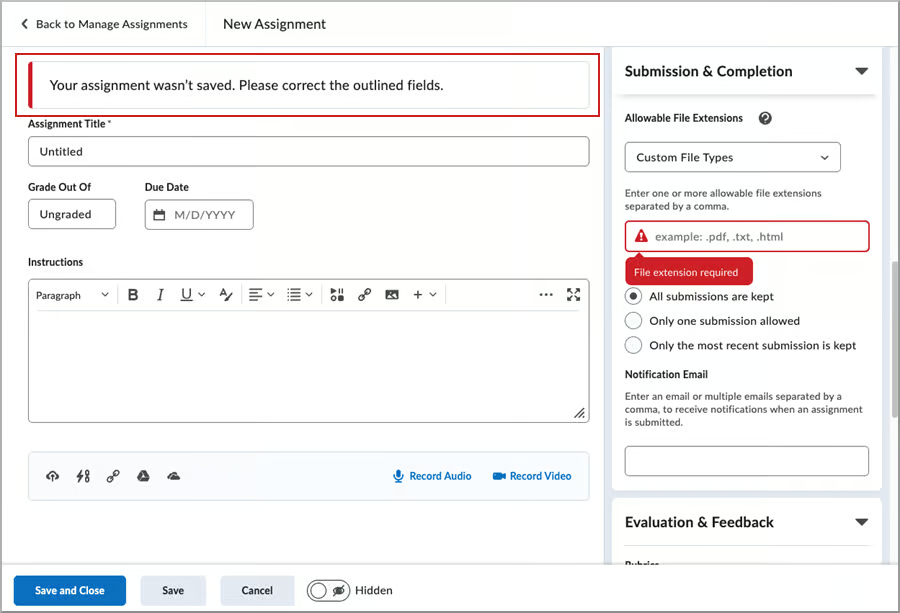
When instructors set Allowable File Extensions to Custom File Types during assignment creation, Brightspace now requires at least one file extension to be entered before the assignment can be saved.
If the field is left blank, Brightspace displays a clear inline error message and prevents the assignment from being saved. This improvement helps instructors avoid invalid assignment configurations and reduces submission issues for learners.
New Assignment page displaying a validation error when Custom File Types is selected without specifying at least one allowable file extension.
Note: These changes improve messaging only and do not alter which file types are allowed for an assignment.
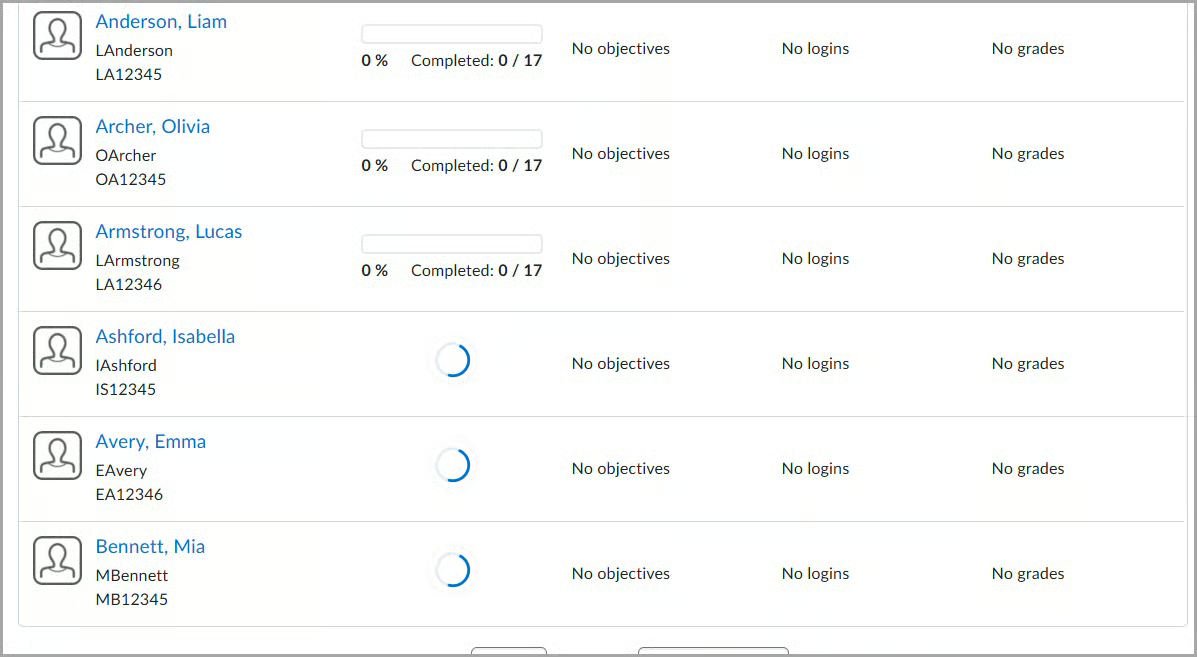
3) Class Progress – User progress for Content charts now loads asynchronously
The completion progress bars for the Content Completed and Content Visited charts now load asynchronously as instructors scroll down the Class Progress page. Progress details appear for each user as they come into view, allowing the page to continue loading smoothly regardless of the number of users or content objects being calculated.
The d2l.Tools.ClassProgress.AsyncContentChartsCount (Org) configuration variable determines the threshold for the number of content objects that triggers content charts to load asynchronously. The default value is 50 content objects and can be increased to a maximum of 1,000.
Completion progress bar charts load asynchronously.
Previously, courses with a large number of users or content objects could experience page timeouts when viewing the Content Completed or Content Visited columns in Class Progress.
4) Grades – Improved navigation within the Enter Grades page
The Enter Grades page now offers improved horizontal navigation, making it easier to work with large gradebooks. Instead of relying on a horizontal scroll bar at the bottom of the page, instructors can use navigation arrows on either side of the gradebook, along with a scroll bar at the bottom of the grid, to navigate across grade columns.
This update also improves how dropdown menus behave, preventing them from appearing underneath other fields such as user names.
Use the left and right arrows to scroll horizontally and view additional grade columns in the Enter Grades table.
Previously, horizontal navigation relied on a scroll bar at the bottom of the page, which was not always visible unless users scrolled down.
Note: Are you doing something innovative in Brightspace or perhaps you've discovered a handy tip? Share how you are using Brightspace in your teaching and learning in The Orange Room.
D2L (the company that owns Brightspace) uses Continuous Delivery to update our Brightspace system. The Continuous Delivery model gives us regular monthly updates allowing for incremental and easily integrated changes with no downtime required for our Brightspace system.
Our Continuous Delivery update occurs on the 4th Thursday of each month. D2L provides release notes to help users stay up-to-date with the changes.
Here are some of the updates in the January 2026/20.26.01 release that were added to our system this month:
1) Announcements – Images appear in emailed Announcement notifications
When instructors create an announcement (or administrators create a global announcement) which includes in-line images, any instant notification or emailed copy of that announcement now includes those images in the body of the email. Previously, only images added as file attachments to the announcement were included with the notification email, and in-line images were not shown.
Note: This update applies only to images. Videos embedded in announcements are not included in emailed announcement notifications.
This change ensures that learners who rely on email notifications can see the same visual content that appears in the original announcement, helping them notice important information that may have previously been missed when images were omitted from the email version.
This feature implements the following PIE items:
D7210 (Images in announcements do not appear in the email-version of the notification)
D12152 (Permit images to be sent in an email notification for an announcement)
D7939 (Include images in Brightspace-generated email of Announcements - partial release; videos are not included)
As part of D2L’s ongoing commitment to accessibility and inclusive design, with this release, they have made several updates to enhance the experience for users relying on assistive technologies.
The Submissions page in Assignments: The dropdown menus for submissions, feedback, and results per page now include accessible labels. Previously, these menus only had titles, which some screen readers could miss. This change ensures that all users can access and understand these controls.
The Submissions view in Quick Eval: The number of search results returned is now read aloud by assistive technology, making it easier for users to understand the scope of their results.
Quick Eval interface displaying filtered submission results, with the number of returned results now read aloudQuick Eval interface showing filtered activity results based on a search query, with the number of returned results now read aloud
3) Awards – Increased flexibility in Awards text fields
To improve localization and language flexibility, administrators and instructors can now personalize certificates in the Awards tool using new replacement strings. These strings populate dates in a short YYYY-MM-DD format, which provides more consistent rendering across multilingual certificate templates.
Previously, existing date replacement strings used long-form formats. This caused issues when certificates were created in one language and the date string rendered in another, often breaking formatting. The new short-form format resolves this issue.
The following replacement strings are now available:
{CourseStartDateShort}: Inserts the course start date.
{CourseEndDateShort}: Inserts the course end date.
{AwardDateShort}: Inserts the award issue date.
{AwardExpiryDateShort}: Inserts the award expiry date.
4) Quizzes – Single Session Quiz
Instructors can now require learners to complete a quiz within a single Brightspace login session, helping maintain academic integrity. When this setting is enabled, learners cannot resume the quiz using another browser session. For example, if a learner starts a quiz on a laptop, they cannot continue the quiz on another device such as a smartphone or tablet.
When this configuration variable is enabled, instructors can navigate to the Availability Dates & Conditions section while creating or editing a quiz and select Lock each attempt to a single login session.
From the quiz’s Availability Dates & Conditions section, select Lock each attempt to a single login session to restrict attempts to one active session
IMPORTANT:
This setting only restricts access to the quiz. It does not prevent learners from having multiple active sessions in Brightspace.
While this feature enhances academic integrity, you should use it with caution. We suggest reserving this option for live testing environments where you are available to assist immediately. If a student experiences a technical glitch or a dropped connection, they will be unable to resume the quiz attempt without your direct intervention to reset the session restriction.
This feature implements the following PIE item:
D11297 (Prevent multiple sessions taking one quiz attempt simultaneously)
Note: Are you doing something innovative in Brightspace or perhaps you've discovered a handy tip? Share how you are using Brightspace in your teaching and learning in The Orange Room.
D2L (the company that owns Brightspace) uses Continuous Delivery to update our Brightspace system. The Continuous Delivery model gives us regular monthly updates allowing for incremental and easily integrated changes with no downtime required for our Brightspace system.
Our Continuous Delivery update occurs on the 4th Thursday of each month. D2L provides release notes to help users stay up-to-date with the changes.
Here are some of the updates in the December 2025/20.25.12 release that were added to our system this month:
1) Assignments – Group Assignment evaluation email enhancements
This release introduces enhancements to the Email Group button in Group Assignment Evaluation.
If a group has no members, or if the users in the group do not have an internal D2L email set up or an external email linked, the Email Group button no longer appears. The button now displays only when it is actionable, reducing confusion and improving interface clarity.
This update enhances the overall experience by aligning with accessibility and usability best practices, ensuring that only relevant options are shown to users.
Previously, the Email Group button appeared even in groups with no users, which caused confusion.
The Email Group button in Group Assignment Evaluation before this update if a group has no membersThe Email Group button no longer appears in Group Assignment Evaluation after this update if a group has no members
2) Discussions – Enforce timely learner engagement with first post due dates
To ensure timely learner participation, instructors can now specify a due date for the first post in a discussion topic. This supports course pacing, institutional policies, and consistent expectations for learner engagement. This mirrors the behavior of Assignments and Quizzes, making the course experience more consistent and predictable.
Previously, instructors could not set due dates for initial discussion posts, which made it difficult to assess timely engagement or enforce deadlines. This update improves grading accuracy, simplifies compliance with participation policies, and supports smoother course migrations from learning management systems that already include this functionality.
The first post due date follows the same behavior as Assignments and Quizzes:
Due dates must be between the start and end dates of the discussion topic.
Availability types (for example, Hidden, Visible with access restricted, Visible with submission restricted) are respected.
Additional improvements include:
Calendar tool integration: The first post due date appears in the calendar.
Notifications: Administrators can enable notifications. When enabled, the due date will trigger a notification in Brightspace and push notification (Pulse App).
Grading: Discussion due dates support automatic-zero grading.
Other enhancements:
In Manage Dates, first post due dates are visible and editable.
In the Discussion List, due dates appear next to each topic.
In New Content Experiences, Overdue and Late indicators appear when deadlines are missed. Classic content will continue to show the due date on the content topic.
In Quick Eval and Consistent Evaluation, first post due dates appear in evaluation workflows.
In the Work to Do widget, due dates appear.
Instructor view of a discussion topic with a first post due dateLearner view of a discussion topic with a first post due date
Note: Discussion due dates must fall within the topic's availability window to appear in the calendar and trigger notifications.
This feature implements the following PIE item:
D143 (Due Date for First Post for Discussions)
3) Groups – Group deletions now processed via background job
To support the ongoing expansion of the Groups tool, all group deletion workflows are now processed asynchronously to reduce timeouts and errors.
Previously, when deleting groups within Brightspace, the web request would sometimes time out when there were too many groups to process.
When a user initiates a deletion, the background process deletes all groups, categories, and their associated activities. While processing, groups and categories appear in the recycling bin indicating that deletion is in progress, and the Restore option is not available. The Restore option becomes available only after the deletion is completed, which may take a few minutes.
This feature applies to all group deletion methods, including via the Manage Groups page, Org Unit Editor, SIS integrations such as Banner or IPSIS, or API deletion routes.
4) Quizzes – Zero point quiz questions
Instructors can now assign 0 (zero) points to a quiz question to collect non-graded information, for example, feedback or personal input.
This feature eliminates the need for workarounds such as assigning 0.01 points or manually adjusting scores after submission. Instructors can enter zero points in the points field for any question type within the quiz, ensuring that these questions do not contribute to the quiz's total points. This feature is especially useful for gathering additional information from learners during a quiz or for implementing an "Honesty Code" question at the beginning of the quiz.
Previously, instructors were restricted from entering zero points for quiz questions.
Example of a quiz question displaying a statement on academic integrity with answer options for True and False, and the points field set to zero
Note: Are you doing something innovative in Brightspace or perhaps you've discovered a handy tip? Share how you are using Brightspace in your teaching and learning in The Orange Room.
D2L (the company that owns Brightspace) uses Continuous Delivery to update our Brightspace system. The Continuous Delivery model gives us regular monthly updates allowing for incremental and easily integrated changes with no downtime required for our Brightspace system.
Our Continuous Delivery update occurs on the 4th Thursday of each month. D2L provides release notes to help users stay up-to-date with the changes.
Here are some of the updates in the November 2025/20.25.11 release that were added to our system this month:
1) Announcements – Email a copy of an announcement to your Classlist
In response to multiple Product Idea Exchange (PIE) submissions, when Instructors create a new announcement in a Course Offering, they can now choose to send a copy to all users in their Classlist as an email, sent as if from the instructor themselves.
In the user interface for creating or editing an announcement, a new Send Email Copy checkbox now appears when an instructor creates or edits an announcement.
The new Send email copy checkbox in Brightspace announcement
When an instructor selects the new checkbox, the system emails the content of the announcement to all users in the Classlist, including those who have opted out of announcement notifications, upon publishing. The email will originate from the email address of the person who publishes the announcement.
The checkbox will be automatically deselected when an announcement is copied or edited, and must be selected again before republishing.
Please be aware that if users are already receiving an automated notification email about announcements, this may result in duplicate or similar emails. Users who are not subscribed to receive a notification for announcements will also receive an email, ensuring that important information contained within the announcement is delivered to every learner.
For consistency with automated emails in Intelligent Agents and assignment submissions, the system sends the message to internal email addresses if users have them. If users do not have internal email addresses, the system sends it to their external email address.
Users without a valid email address will not receive an emailed copy of the announcement.
For announcements scheduled to publish at a later date, clicking the Send email copy checkbox emails the copy to users in the Classlist at the time that the announcement is published.
This feature implements the following Product Idea Exchange (PIE) items:
D1923 (Email Notification Option when Creating New News Items)
D3817 (Default email notification when publishing a news item)
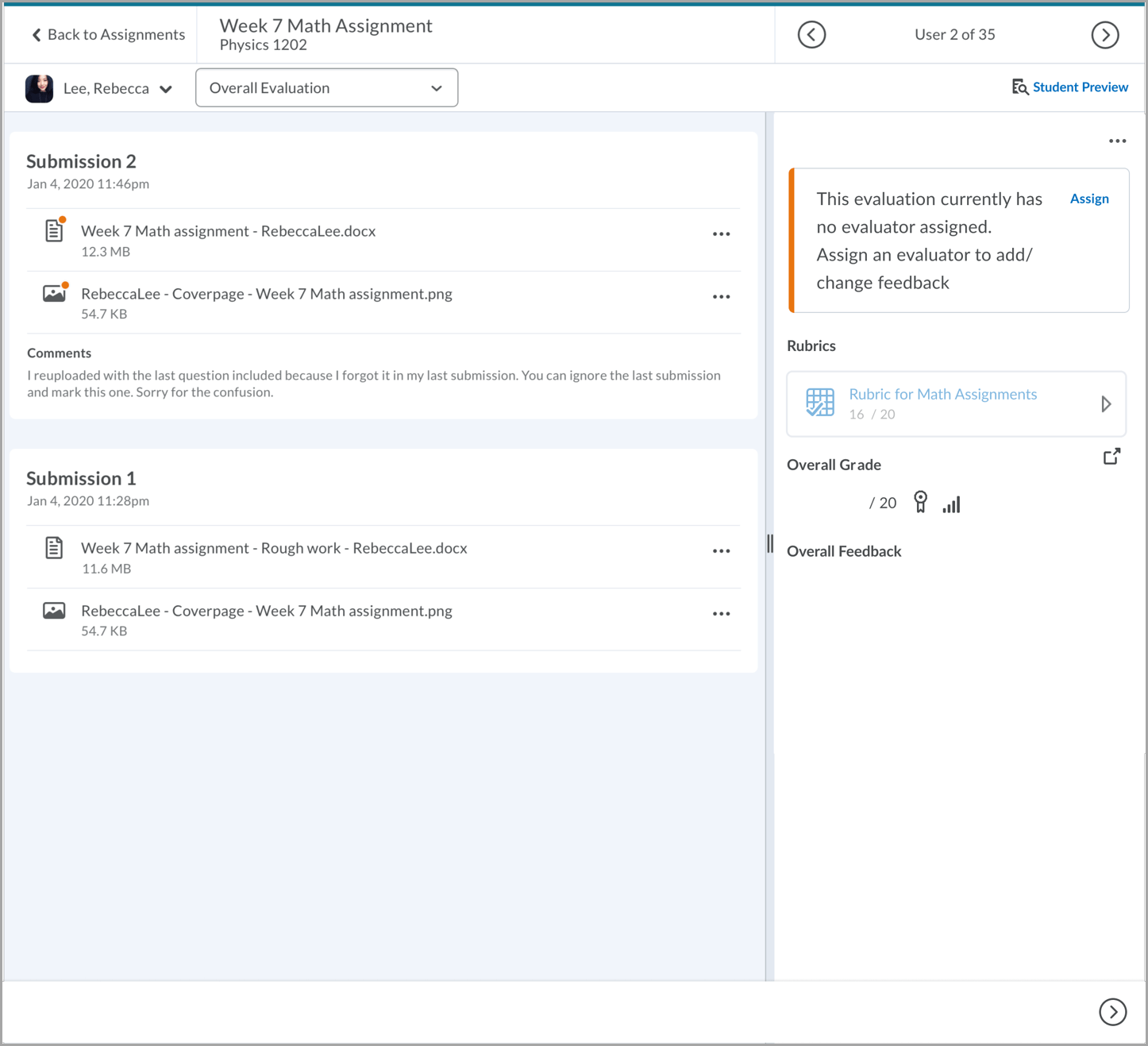
2) Assignments – Advanced Assessment now shows when an evaluation has no designated evaluator
A new alert in the assignments user interface now notifies instructors when an evaluation currently has no evaluator assigned, so they can quickly identify the problem and take steps to assign a new evaluator.
This update helps prevent unexpected evaluation errors and improves clarity, especially for institutions with large enrollments and multiple sections.
Previously, if an instructor used Advanced Assessment features to delegate evaluation to a user who later became unenrolled from a course, there was no way to identify which submissions needed to be assigned a new evaluator. Learner submissions could remain unevaluated for extended periods of time, causing confusion and errors.
An example of a warning message when an assignment has no assigned evaluator
3) Brightspace – Progress bar for uploading files
With this release, Brightspace improves visual consistency and accessibility by updating progress bar indicators across several tools. These improvements enhance support for screen readers and assistive technologies.
Visual indicators have been updated in the following areas:
New Content Experience – Upload a file
Quizzes – Add Existing Question
Import Quiz Questions – Upload a file
Quiz Study Support – Check if the quiz meets the study support requirements
Generate Question – Choose a file to generate a question
Content Uploader – Upload a file
Manage Groups – Export progress bar
Upload File (Classic Content) – Upload a file
An example of the progress bar updating as a user adds a module to the Table of Contents in Brightspace, indicating the step-by-step progress
4) Brightspace Editor – Equation editor now uses the latest WIRIS version
The equation editor Instructors and Learners use to compose equations in the Brightspace Editor (WIRIS) has been updated to the latest version, 7.24.0.
This update includes no functional changes to the equation editor, but does include WIRIS defect fixes.
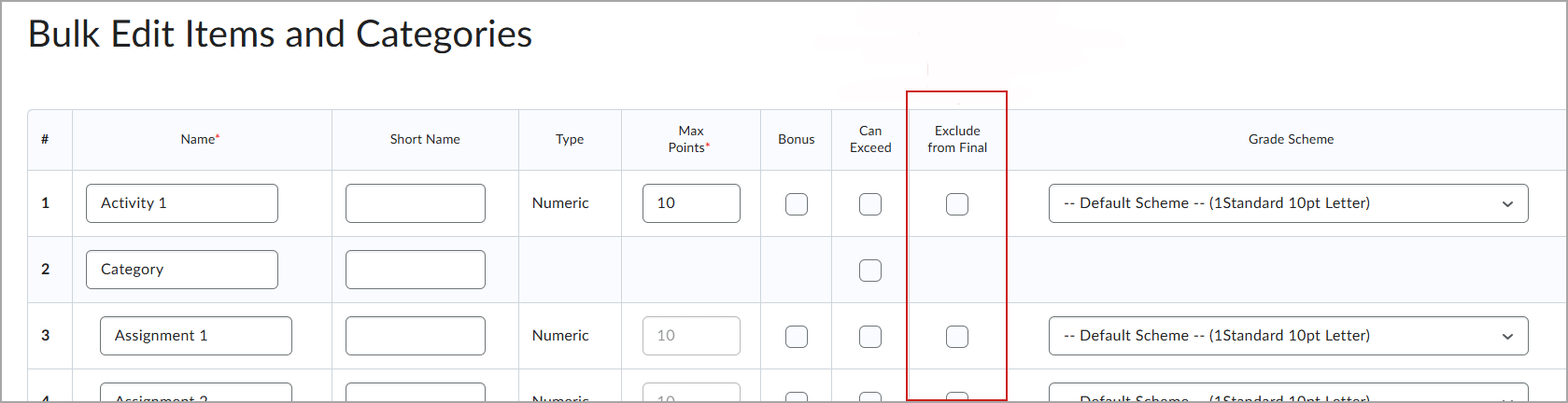
5) Grades – Bulk edit now supports excluding items from final grade
Instructors can now use the Exclude from Final column when bulk editing grade items in the Grades tool. Selecting this option excludes the grade item from the final grade calculation.
Previously, this setting was only available when editing individual grade items. This enhancement helps instructors manage large grade books more efficiently by allowing them to update multiple items at once.
In the Bulk Edit Items and Categories page, select Exclude from Final for each item to omit from the final grade
Note: This option is only available in courses using the Points grading system. Courses using Weighted or Formula grading systems can exclude items by assigning a weight of 0 or excluding them from the formula, respectively.
This feature implements the following PIE items:
D1773 (Bulk Edit Grade Item)
D9984 (Course-level configuration to include/exclude grade from Final Grade)
Note: Are you doing something innovative in Brightspace or perhaps you've discovered a handy tip? Share how you are using Brightspace in your teaching and learning in The Orange Room.
D2L (the company that owns Brightspace) uses Continuous Delivery to update our Brightspace system. The Continuous Delivery model gives us regular monthly updates allowing for incremental and easily integrated changes with no downtime required for our Brightspace system.
Our Continuous Delivery update occurs on the 4th Thursday of each month. D2L provides release notes to help users stay up-to-date with the changes.
Here are some of the updates in the October 2025/20.25.10 release that were added to our system this month:
1) Assignments — Annotation availability awareness enhancements in assignment creation
Annotations are only supported for File and File or Text Assignment Types. They are not supported for Text, Observed in person, or On paper submission assignment types. In response to requests from instructors for clearer indicators of which types of assignments support Annotations, D2L enhanced the assignment creation experience with better tool tips, visual cues, and on-screen guidance.
New informational tool tip
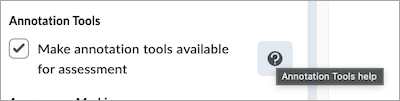
To make it easier for instructors to understand what the Annotations tool does and which types of assignments you can use it with, a new informational tool tip now appears beside the existing Annotations check box in the interface for creating assignments.
When you hover over the new information ( ? ) button, a tool tip displays Annotation Tools help.
New Annotation Tools help tool tip
Clicking the information ( ? ) button opens a pop-up window that explains what the Annotations tool does, and which types of assignments you can use it with. The text in the new window is as follows:
Information: Annotation Tools
Use annotation tools to add feedback directly to the uploaded documents by highlighting, drawing, and commenting. This is available for file submissions only.
New Annotation Tools informational pop-up window
Clear visual indicators make it easy to identify which assignment types support Annotations
To make it easier to immediately understand whether you can use Annotations on an assignment, the Annotations check box now appears disabled (grayed out) for non-file type assignments, such as Text, Observed in person, or On paper submission assignments.
Visual cues indicate when Annotation Tools are not available for an assignment type
Updated on-screen guidance
New on-screen guidance indicates when instructors can no longer enable Annotations for an assignment and why.
Guidance for non-file Assignment types
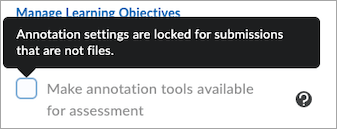
When you cannot enable Annotations for an assignment because the type is Text, On paper submission, or Observed in person, hovering over the Annotations check box displays the following message:
Annotation settings are locked for submissions that are not files.
New on-screen guidance shows when Annotation settings are locked because the assignment type is not File or File or Text
Guidance displayed for assignments after submissions are received
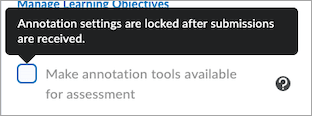
When you cannot enable Annotations for an assignment because learners already made submissions while the setting was disabled, hovering over the Annotations check box displays the following message:
Annotation settings are locked after submissions are received.
New on-screen guidance shows when Annotation settings are locked because learners made submissions for the assignment while Annotations were disabled.
2) Assignments — Improved assignment type selection interface
A usability improvement makes it easier to select the correct assignment type when you create an assignment.
Previous behavior
Previously, instructors used radio buttons to specify whether an assignment was for a Group or an Individual.
New drop-down menu for selecting Assignment type
A new drop-down menu for selecting the Assignment Type modernizes the interface and lays the groundwork for future enhancements to the Assignments tool.
New drop-down menu with Individual Assignment Type selected
3) Grades – Comments and Assessments column always visible to learners
Learners can now always see the Comments and Assessments column in Grades, ensuring that feedback and links to assessments are consistently visible. The column is no longer conditionally displayed, supporting additional links from tools such as Rubrics, Assignments, and Quizzes.
This update supports future enhancements that add information to learner feedback in Grades.
Previously, the column only appeared when a grade item included feedback.
Comments and Assessments column now appears consistently to learners in Grades
4) Media Library – Improved Media Library to help better organize and manage your course assets
This release introduces several new features to improve the capabilities of the Media Library and allow users to have a wider variety of assets that can be reused in their courses.
These improvements include:
Add Images, Office Documents, PDFs, and SCORM packages directly to Media Library for re-use across your courses.
Use Media Library’s new Manage Versions menu to upload and manage a new version of your asset.
Create folders to better organize your assets by type, subject, or however you’d like.
Share a folder with another user by adding them to a folder as a collaborator.
Manage Versions menu option in Media Library
The following file types can be uploaded to Media Library:
Video: .mp4, .avi, .f4v, .flv, .m4v, .mov, .webm, .wmv, and the ability to optimize for streaming (2GB max and up to 720p output)
Create Folder window in Media Library with options to save or cancel
5) Quizzes – Hide Quiz Question Points
Instructors can now hide the point value for quiz questions to ensure learners focus on all questions equally, without the risk of inferring the number of correct answers based on point value. This feature is particularly useful in scenarios like employee training and association quizzes.
The new feature helps with the following:
Avoiding Hints in Multi-Select and Written Response Questions. Hiding point values prevents learners from guessing the number of expected answers based on the score, promoting a more consistent effort across all question types.
Diagnostic Assessments. This option is beneficial for assessments like subject knowledge audits or start-of-term baseline knowledge checks, where the purpose is to gauge understanding rather than focus on scoring.
Encouraging Equal Effort Across Questions. By hiding point values, learners are less likely to prioritize certain questions over others based on points. Hiding point values ensures a balanced effort and enables the inclusion of control or bonus questions without indicating their significance.
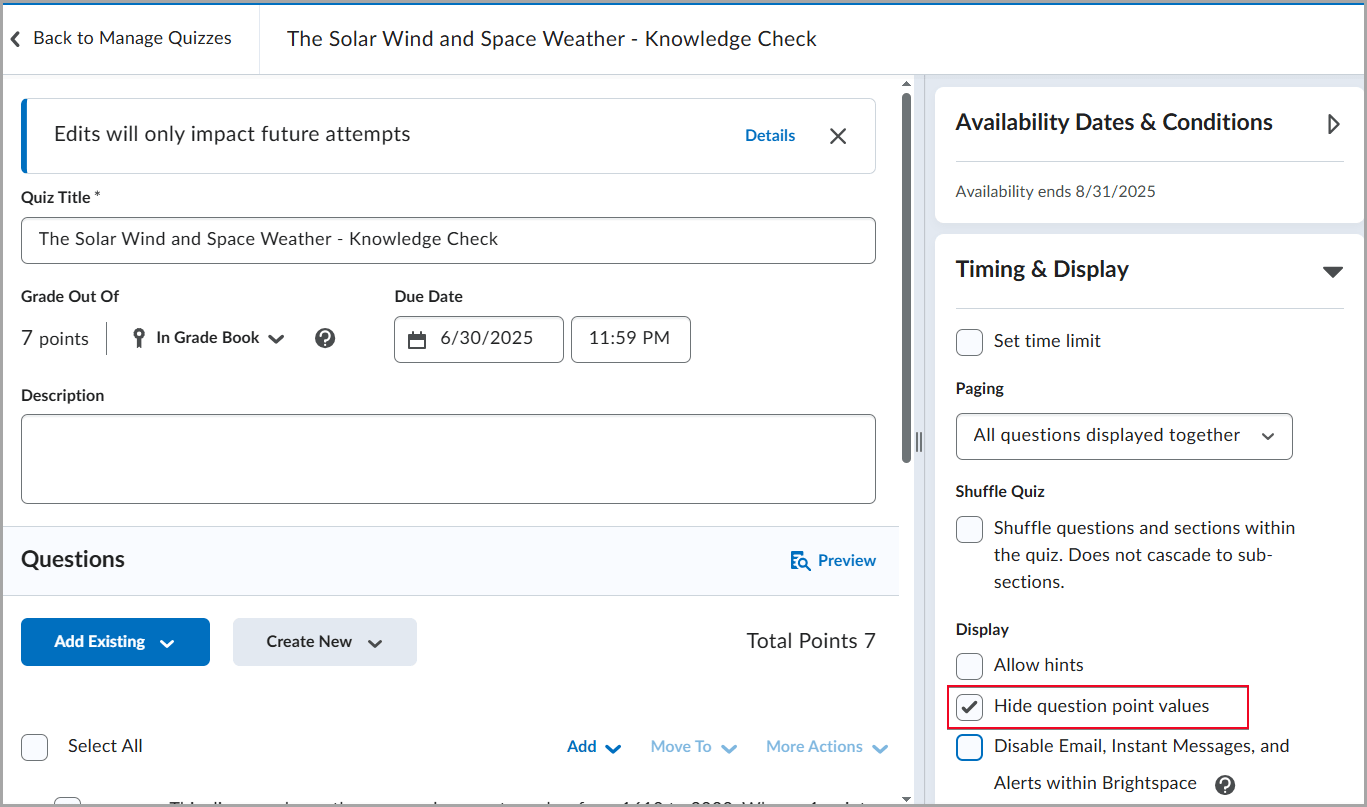
A new option is available within the Timing & Display section when creating or editing a quiz.
From the Edit Quiz page, under Timing & Display, select Hide question point values to prevent learners from seeing individual question scores
This feature implements the following PIE items:
D2934 (Hide point value of quiz questions)
D10418 (Option to hide point value of quiz questions and show linked Learning Outcomes)
6) Quizzes – Improved visibility for insufficient question pools
With this release, instructors can now see a status indicator when a question pool has insufficient questions, allowing them to resolve the issue before learners begin a quiz attempt.
If a quiz attempts to draw more questions than are available in a question pool (for example, 12 questions requested but only 10 available), the interface now displays a warning indicator.
This update adds visual warnings in the following areas:
The Grading view: If learners have already completed a quiz containing an affected pool, messaging displays in the grading evaluation experience.
When grading a quiz, an error message appears indicating the question pool is exhausted
The Manage Quizzes page: A status indicator flags quizzes with insufficient question pools.
In the Manage Quizzes tab, a red warning icon appears beside a quiz name. Instructors can review quiz settings to resolve the issue
The Edit Quiz page (Quiz Builder): A warning icon appears directly on the affected question pool.
The Edit Quiz page displays a Question Pool with an error state, labeled Invalid Question Pool
The Course Import and Course Copy workflows: Validation now prevents importing or copying pools with an insufficient number of questions.
Previously, no visual indicators identified when question pools contained too few questions, and these could be imported or copied without warning.
7) Quizzes – Attempt exports retain line breaks in question content
Instructors can now export quiz attempts using the Export to CSV and Export to Excel options without removing line breaks in question text or answers.
Previously, line breaks in question text and answers were removed during export.
Note: Are you doing something innovative in Brightspace or perhaps you've discovered a handy tip? Share how you are using Brightspace in your teaching and learning in The Orange Room.
D2L (the company that owns Brightspace) uses Continuous Delivery to update our Brightspace system. The Continuous Delivery model gives us regular monthly updates allowing for incremental and easily integrated changes with no downtime required for our Brightspace system.
Our Continuous Delivery update occurs on the 4th Thursday of each month. D2L provides release notes to help users stay up-to-date with the changes.
Here are some of the updates in the August 2025/20.25.08 release that were added to our system this month:
1) Brightspace – New Window icon for all menu items
To help users better anticipate navigation behavior in Brightspace, a New Window icon now appears next to all menu items that open in a new tab or window. This change applies to all applicable menu items across the platform interface.
The icon design is also updated to better align with current styles used in Brightspace.
View an example of this change in the Print Thread menu in a discussion topic (see image).
The New Window icon appears beside a menu item.
From a course, navigate to a topic in Discussions, select the actions drop-down for a thread, then view the New Window icon appears beside Print Thread.
2) Groups – Enrollment limit increase
To support growing class sizes, the Groups tool now allows enrollment of up to 3000 users per group within a group category. Previously, the limit was 200 users per group.
This increased limit applies to all enrollment workflows, including:
Automatic enrollment during group creation
Automatic enrollment during Classlist enrollment, where automatic enrollment group types exist
Manual enrollment using the Enroll Users and Import options within the Groups tool
Groups enrollment via the Bulk User Management tool
Enrollment using Brightspace APIs
The 3000-user limit is now strictly enforced across all methods of group enrollment. Previous workarounds that bypassed the former enrollment limit will no longer function for any group that has reached the 3000-user limit.
Currently, the automatic enrollment overflow functionality enrolls users into other groups in the same category if the selected group is full. However, when the 3000-user limit is reached in all groups, further enrollment attempts will fail. To continue processing enrollments, you must add additional groups to the category.
In cases where enrollment fails due to the user limit, the following indications appear:
Brightspace APIs return an error
Bulk User Management and Group Import CSV display user-specific errors in the import results
IPSIS and Banner integrations report failures
In the Groups tool, additional users cannot be selected without deselecting users already enrolled in the group
D6942 (Allow for more than 200 people in a group/section)
D4750 (Remove 200 member cap on Self-enrolling Groups)
3) Quizzes – Print your quiz
In response to customer feedback, this update provides instructors with a simple way to print an offline quiz that supports all native Brightspace quiz question types, shuffling and randomization options, question pools, multiple versions, and an Answer Key.
From the Manage Quizzes page, click the drop-down beside the quiz name and select Print.From the Print Quiz page, select a version tab, configure formatting, and click Print [Version].
Options to support multiple quiz versions include:
Shuffle Quiz (under Timing & Display) to shuffle quiz sections and questions.
In the Timing & Display section of the quiz settings, select Shuffle Quiz to randomize the order of questions and sections within the quiz.
Shuffle questions in this section (when creating or editing a section).
When creating or editing a quiz section, select Shuffle questions in this section to randomize questions, sections, and pools within the section.
Randomize answer order when creating or editing a supported question type, for example, Multiple Choice.
When creating a multiple-choice question, select Randomize answer order to present answer choices in a different order for each learner.
To help instructors quickly and easily grade printed quizzes taken offline, an Answer Key is provided for each version. It includes the correct answers and, where applicable, the grading method.
To grade a quiz, instructors can select Show correct answers and print the required version of the quiz with an Answer Key.
This feature implements the following PIE items:
D362 (Print Quiz and Quiz Key)
D3718 (Quizzes - Generate PDF of the Quiz for Printing)
D5909 (Make all screens which have "forms" exportable to PDF)
D8049 (Printing Quiz)
D11794 (Quizzes: Print Test for Offline Completion)
4) PIE – Enhancement to the Product Idea Exchange (PIE)
This update enhances the Product Idea Exchange (PIE) based on customer feedback and introduces a new idea submission pipeline. D2L is refocusing on using PIE for new product ideas only. For bugs, support issues, or feedback on existing features, customers should use the Customer Support Portal or speak with your Customer Success representative. Updated guidelines for PIE are available in the Community.
This update makes it easier to:
Engage directly with the D2L Product Management team
Receive faster updates on submitted ideas with simplified statuses and streamlined process
Gain visibility into how ideas influence the product roadmap
D2L will provide feedback on submissions that do not follow the updated guidelines to provide an opportunity to update the submissions. Submitters receive a notification and have 90 days to enhance it.
D2L is also reviewing existing PIE submissions to inform migration plans. Customers are encouraged to revisit older submissions marked as Feedback Review Window and provide comments on those still relevant.
The current PIE interface remains open for commenting until August 31, after which it becomes read-only for six months to allow historical reference and migration.
Note: Are you doing something innovative in Brightspace or perhaps you've discovered a handy tip? Share how you are using Brightspace in your teaching and learning in The Orange Room.
D2L (the company that owns Brightspace) uses Continuous Delivery to update our Brightspace system. The Continuous Delivery model gives us regular monthly updates allowing for incremental and easily integrated changes with no downtime required for our Brightspace system.
Our Continuous Delivery update occurs on the 4th Thursday of each month. D2L provides release notes to help users stay up-to-date with the changes.
Here are some of the updates in the July 2025/20.25.07 release that were added to our system this month:
1) Assignments – Flexible text or file submission options for enhanced learner choice
This feature enables instructors to create a new assignment type that accepts submissions in the form of an uploaded file, text entered in Brightspace Editor, or both.
To create this new type of assignment, instructors must go to the New Assignment page, expand the Submission & Completion panel, open the Submission Type dropdown, and select the new File or text submission option.
The new File or text submission option appears in the Submission Type dropdown on the New Assignment page.
For these assignments, learners can choose how they want to demonstrate their learning. For example, if the assignment is an essay, learners can upload a file, paste a link to an external file in the text box, or type the entire essay into the text box. For assignments restricted to only one file, learners still have the option to add a text submission. Learners will also see an expanded Brightspace Editor for text submissions on the assignment submission page.
The new Submit Assignment page for learners, showing the option to submit files and the option to enter text in Brightspace Editor.
Previously, the available Submission Types were: File submission, Text submission, On paper submission, and Observed in person.
Note: Text submissions are not supported by the Annotations tool.
This feature implements the following PIE item:
D4773 (Assignment Folders should accept BOTH a file and a text submission type not just one or the other)
2) Groups – All group enrollments now processed via background job
To support upcoming changes to increase group enrollment limits planned for August 2025, all group enrollment workflows are now consistently handled by a background job.
Previously, group enrollments created through the Groups tool, APIs, and course copy operations were processed asynchronously to reduce timeouts and errors. With this update, all group enrollment methods (through the Manage Users tool, Classlist enrollments that add users to groups, enrollment APIs, Banner integrations, and Self Registration) are processed using the same background job mechanism.
For end users, this update ensures that when they complete an enrollment in a course offering, any corresponding group enrollments within that course are also processed automatically. This background process may take one to two minutes to complete.
This feature provides consistent and efficient group enrollments across tools and workflows, ensuring a seamless experience as enrollment limits increase, and preventing timeouts and errors during high-volume events.
3) Groups – Bulk enroll and unenroll users by CSV file import
Instructors can now bulk enroll or unenroll learners in existing groups using a comma-separated values (CSV) file in the Groups tool. This feature adds a new Import button to the Manage Groups page and an Import option in the Category drop-down menu. Clicking Import opens a guided workflow with detailed instructions for correctly formatting the CSV file. Each line in the file must represent a single action: either enrolling or unenrolling a learner from a specific group in the course. CSV file modifications are limited to learners currently enrolled in the course.
Once uploaded, the system validates the CSV file. If the file contains no errors, the enroll or unenroll actions are performed, and once completed, the import results are displayed immediately. If there are any errors found in the file, the process stops and generates a list of errors found.
Cancelling the process does not reverse completed actions. Only one import process can run at a time.
Administrators can configure the CSV file format in the Form Elements tool using the new form element BulkGroupEnroll. The following form element properties are customizable:
Username
Org Defined Id
Group Name
Group Code
Either Username or Org Defined Id, and Group Name or Group Code, are required to ensure there is enough information to complete the enrollment or unenrollment action.
The new workflow is available to roles with the Groups and Sections Management > Create/Edit/Delete Groups and Categories permission enabled.
The new Import option appears on the Manage Groups page and in the Category drop-down menu.The new Import page includes instructions to create a CSV file for enrolling and unenrolling users.After uploading a file, the Import page displays the process and checks for errors in the file.
This feature implements the following PIE items:
D8710 (Group enrollment from a file)
D7963 (Improve Group enrollments for 100+ students)
D294 (Create Groups and/or enroll students in Groups using a CSV Spreadsheet)
D6790 (Enrolling students in groups)
D11671 (Allow instructor to bulk enroll students across ALL group categories at once)
4) Quizzes – New Quiz Evaluation Experience is the default
Initially introduced in September 2024/20.24.9, the New Quiz Evaluation Experience is now enabled by default for all clients.
5) Quizzes – Full HTML Editor for Question Feedback
This update introduces the full HTML editor for question-level feedback in Quizzes, enhancing the instructor experience and aligning it with the editors already available for Attempt Feedback and Overall Feedback, including support for the equation editor and file upload features.
Previously, instructors could provide feedback on individual questions using only the inline HTML editor, which offered limited formatting and functionality. With this update, instructors can now:
Upload files securely
Insert equations
Use advanced formatting and media tools
The question Feedback editor now includes extended options.
This feature implements the following PIE item:
D12335 (Add the equation editor to the question feedback in the new quiz evaluation experience)
6) Quizzes – Reopen a submitted quiz attempt
Instructors can now reopen the most recently submitted quiz attempt, allowing learners to resume from where they left off. The new feature supports scenarios where learners run out of time or submit their attempt by mistake, reducing frustration from auto-submissions and improving overall quiz management flexibility.
Previously, instructors could not reopen a submitted quiz attempt. This update introduces the ability to return quiz attempts to an unsubmitted state and adjust time limits if needed.
Reopen a quiz attempt from Manage Quizzes by selecting an attempt and clicking Reopen.In the Reopen Quiz Attempt dialog, instructors can add extra time and confirm the reopened attempt.
This feature implements the following PIE items:
D1993 (Allow instructors the ability to unsubmit a quiz attempt)
D6069 (Re-Open a Quiz)
D6230 (Resume Quiz with Set Time Limit)
D7653 (Un-submit quiz option for instructor)
D7804 (Change Reset Quiz Attempt Workflow)
7) Quizzes – Statistics available for rubrics on written response questions
Instructors can now view rubric statistics for rubrics associated with written response questions across all learners’ first attempts in a quiz. Both Overall Statistics and Criteria Statistics are included with this update.
Previously, rubric statistics were limited or inconsistent for written response questions. With this update, the rubric statistics display data per quiz question for all users, not just the quiz overall.
The user interface clearly indicates that only first attempts with text are included in the stats.
This update provides instructors with consistent rubric statistics across all assessment types for better insight into how learners perform on written response questions in particular.
8) Rubrics – Options to improve rubric management
To improve efficiency when reviewing assessments, instructors can now clear rubric scoring using the new Clear Selections option.
This update supports instructors who need to reset scoring and start from scratch. Clearing the rubric score does not remove any previously entered feedback.
Click Clear Selections in the confirmation dialog to remove rubric scoring.
Selecting Clear Selections requires users to confirm the action. The option to undo this action appears in a pop-up window for a brief amount of time after clicking Clear Selections.
Previously, to modify scoring, instructors had to manually clear each rubric level.
In addition to the Clear Selections menu option, the Set All Ungraded option is also updated. When no rubric levels are selected, the option now appears as Set All to Yes and Set All to No in the menu.
Set All to Yes and Set All to No menu items are now available in Rubrics.
This improvement follows the recent release of the Set Ungraded option in the January 2025/20.25.01 release, to make it easier to manage rubric scoring.
Note: Are you doing something innovative in Brightspace or perhaps you've discovered a handy tip? Share how you are using Brightspace in your teaching and learning in The Orange Room.
D2L (the company that owns Brightspace) uses Continuous Delivery to update our Brightspace system. The Continuous Delivery model gives us regular monthly updates allowing for incremental and easily integrated changes with no downtime required for our Brightspace system.
Our Continuous Delivery update occurs on the 4th Thursday of each month. D2L provides release notes to help users stay up-to-date with the changes.
Here are some of the updates in the June 2025/20.25.06 release that were added to our system this month:
1) Awards – Replacement strings for award issuer on certificates
Administrators and instructors can now personalize certificates and certificate templates in the Awards tool using new replacement strings. The {IssuerFirstName} and {IssuerLastName} strings insert the first and last name of the user who manually issues a certificate to a learner.
For manually issued certificates, the issuer name will utilize the name of the user that issued the certificate. In cases where a certificate using these replacement strings is conditionally released, the issuer name areas of the certificate will utilize the name of the account set by the d2l.Tools.Awards.AwardUserId configuration variable.
Note:
The replacement strings use preferred names if they are configured at the organization level.
If the issuer updates their name, the name that displays on the certificate reflects the current name setting at the time of issuance. Previously issued certificates do not update.
Depending on the certificate template, the inserted text may extend beyond the text box borders. Administrators and instructors may need to adjust the template layout to ensure issuer names appear correctly.
Note: Are you doing something innovative in Brightspace or perhaps you've discovered a handy tip? Share how you are using Brightspace in your teaching and learning in The Orange Room.
D2L (the company that owns Brightspace) uses Continuous Delivery to update our Brightspace system. The Continuous Delivery model gives us regular monthly updates allowing for incremental and easily integrated changes with no downtime required for our Brightspace system.
Our Continuous Delivery update occurs on the 4th Thursday of each month. D2L provides release notes to help users stay up-to-date with the changes.
Here are some of the updates in the May 2025/20.25.05 release that were added to our system this month:
1) Assignments – Retract feedback in bulk on the Submissions page
The Submissions page in the Assignments tool now aligns with Discussions and Quizzes, allowing instructors to retract feedback in bulk. This enhancement improves consistency and eliminates the need to use multiple tools for retraction tasks.
The bulk Retract Feedback option allows instructors to choose how many learners to retract published feedback from.
Selective retraction is also supported. Instructors can select users by checking the box next to their names and then clicking More Actions > Retract Feedback.
The More Actions > Retract All option retracts feedback for all users, regardless of which users are selected.
From the Submissions page, click More Actions and select Retract All to remove published feedback in bulk.
After clicking Retract All, instructors are notified of the number of evaluations to be retracted and must confirm by clicking Retract.
A confirmation dialog displays the number of learners affected. Click Retract to proceed or Cancel to exit.
Previously, instructors could only retract feedback individually in the Assignments tool.
This feature implements the following PIE items:
D1361 (Allow method to bulk unpublish dropbox feedback)
D5593 (Retract Assignment Feedback in Bulk)
2) Quizzes – Improved quiz monitoring with Session IDs in Attempt Logs
This release introduces the new d2l.Tools.Quizzes.ShowSessionId (Org Unit) configuration variable, which allows administrators to control whether instructors can view the Session ID column in quiz attempt logs.
When enabled, instructors can use session IDs to discern when learners have multiple sessions within a quiz attempt, helping detect potential academic dishonesty.
Check the Session ID column when viewing Attempt Logs > Detailed.
3) Quizzes – Enhanced Learner Submission View
The quiz submission page now features a sleeker, modernized layout. The previous banner image has been replaced with a checkmark icon, along with other visual updates.
The quiz submission page before this update.The quiz submission page after this update.
4) Groups – Export group enrollment data
Instructors can now export group enrollment data from the Groups tool for group-specific class lists and contact list creation.
A new Export button now appears in the Groups tool for users with the Manage Groups and Categories permission. Instructors can use this button to export group data to a CSV file. The exported content includes:
Group category details
Group names
User enrollment information
Enrollment dates
You can choose a specific group or all groups within a selected category to include in the export.
Previously, there was no built-in method to export group data or user enrollment dates from the Groups tool.
From the Manage Groups page, click Export to download group data.From the Export page, use the Select Category and Select Group drop-downs to choose the desired group set, then click Export to download group data.
This feature implements the following PIE items:
D295 (Export Groups: Export Group Enrolments and/or Statistics to a CSV spreadsheet)
D9175 (Add times and dates of students enrolled in groups created)
This feature partially implements the following PIE items:
D7413 (Viewing Group Category/Group Enrollments Quickly)
D345 (Show all Group Categories (or more than one Group Category) on the main Groups page)
D5236 (Printing Groups)
D454 (Group Statistics: View the date and time students self-enrolled in a group)
5) Quick Eval – Evaluate learners across Assignments, Discussions, and Quizzes
This release enables instructors to quickly iterate through their list of submissions in Quick Eval even if those submissions are sourced from different activity types or courses. For example, an instructor has activities to grade in Assignments, Discussions, and Quizzes and has been assigned items that appear in Quick Eval Submissions. The instructor directly accesses each submission to evaluate the items instead of navigating back to Quick Eval and going into each item again.
Previously, instructors had to click into each submission to view the evaluation and then click Back to Quick Eval to go to the Submissions view and then find the next submission to evaluate. With this release instructors are redirected to the next evaluation as listed in the Quick Eval.
From the Submissions view, select a submission and click on the linked learner’s name. In the activity evaluation page, use the forward and backward arrows to toggle to the next or previous learner to evaluate.
This feature implements the following PIE items:
D5475 (Add a "Next Item" button when grading from Quick Eval)
D8199 (Auto Advance to next item in Quick Eval)
6) Pulse – View recurring events
Pulse now displays recurring events from the Events tab. This ensures that any recurring events that an instructor creates using the Calendar tool properly displays in Pulse. Previously, recurring events did not display in Pulse.
7) Notifications – Unsubscribe from all
To improve user experience and reduce unwanted emails, notification emails from Brightspace now include an Unsubscribe link. Selecting the link opens a confirmation screen that allows users to opt out of email notifications, including instant and summary notifications.
Previously, users without login access could not unsubscribe unless they logged in to adjust their notification settings.
The Unsubscribe All Notifications confirmation page appears after clicking Unsubscribe in an email.
Note: Are you doing something innovative in Brightspace or perhaps you've discovered a handy tip? Share how you are using Brightspace in your teaching and learning in The Orange Room.