Skip to content

Brightspace, our Learning Management System (LMS), is designed with accessibility in mind. However, it is the responsibility of the instructor and/or course designer to ensure their course content is formatted using best practices for accessibility; including the use of good heading structure, text formatting, contrast and color, descriptive links, alternative text, tables, lists, etc.

I am writing a series of accessibility related blog posts that will provide suggestions on how you can make small changes when creating course content to make it accessible. This is the third tip in my series of accessibility related blog posts and it focuses on descriptive links.

Signpost showing two arrows: one pointing left and the other right, suggesting different directions to take.

Links are like sign posts. They should tell you what you will find when you follow them. When using a computer, people are generally skimming pages for links. They tend to skim pages to quickly find what they are looking for.

Text links on a page are easily identifiable to persons who are not visually impaired because they are normally colored and underlined, and therefore stand out from the other information on the page.

Persons with a visual impairment using screen reader software are presented with a “links list” with all the available links found on the page. Screen reader users and persons using text-to-speech browsers often navigate websites going from link to link using the tab key, so providing descriptive links is extremely important.

Link text stands out in the same way that bold text does. If all your links have non-descriptive link text like "click here" or "more information" users are forced to read the text around the link to understand the context of the link and where it will take them. Therefore "click here" and “more information” are more of a hindrance than a help.

A non-descriptive link text example showing 'More Information' as the link text and website the link goes to is not clear.

For effective skimming, both visual and non-visual users benefit from link text that can stand on its own without the surrounding context of the page. Good link text provides a clear description of the page that will load when following a link. With good descriptive link text, users can skim links and make quick informed decisions about the path to take to accomplish their task. With non-descriptive link text, users cannot ascertain where the link will take them from the link text alone. Therefore, you should avoid non-descriptive link text such as:

  • Click here
  • Here
  • More information
  • Read more
  • Continue

These types of non-descriptive link text offer no explanation and require users to expand their focus to the surrounding context or follow the link to discover its destination.

When choosing descriptive links the link text needs to be long enough to convey the purpose of the link and no longer. Make link text clear and self-explanatory to support quick and effective navigation.

A descriptive link example showing 'Smithsonian Museum of Natural History' as the link text that will take users to that website.

When scanning links, the first words in the link text are the ones most likely to grab the user’s attention. Link text that begins with keywords is easier to scan efficiently and works better with software features like "link lists" that visually impaired individuals use to get an alphabetized list of links on a page.

Links beginning with non-descriptive words are not very helpful. Consider these two examples "All about ocean acidification" and "Learn more about global warming." Scanning these links will be slower and the alphabetized links list is not going to be very useful. A better approach is to use only the keywords for link text. For example those two links could be improved if they were formatted as "All about ocean acidification" and "Learn more about global warming."

A content topic in a Brightspace course that highlights two descriptive links in the topic description, improving clarity and usability for users.
A content topic description that highlights two descriptive links, improving clarity and usability for users.

Some users make links out of entire sentences or entire paragraphs. These long links are probably unnecessary and are not user-friendly for screen reader users. Remember that screen reader users cannot visually scan through lengthy links. They have to listen to the entire text. Some screen reader users get frustrated with long link text and move on to the next link if they cannot understand the purpose of the link after the first few words.

URLs are not always human-readable or screen reader friendly and therefore using URLs as link text should usually be avoided. Exceptions are when the document is intended to be printed or if the URL is relevant content.

In most cases, it is better to use human-readable text instead of the URL. The human-readable link Design for All Learners: Create Accessible and Inclusive Learning Experiences is more user-friendly than the link to purchase the book by the same title on Amazon.com, which consists of this 115-character link full of letters, numbers, slashes, and text that is not very human-readable (https://www.amazon.com/Design-All-Learners-Accessible-Experiences/dp/1957157895/ref=cm_cr_arp_d_product_top?ie=UTF8.)

Additionally, links don't always lead to web pages. It is equally important to make this clear in your link text. Users appreciate knowing in advance, for example, that if they click on a link on their mobile device they will download a 20Mb PDF. In this case, the link text should indicate that it is a link to a file, including type and size of the file. Here's an example: Assignments Tool Quick Reference Guide (pdf 587KB).

Hyperlinks that are good for both accessibility and usabilty use descriptive text and retain the standard underline style.

Example: Descriptive Links
Ugly (and unclickable): https://webaim.org/techniques/hypertext/link_text
Bad: Click here to learn more.
Good: Accessible link text and appearance by WebAIM
NOTE: You can find more information about link text and appearance at Web AIM.

You will remove significant barriers for the visually impaired if you take these suggestions into consideration when creating course content. An added bonus is that there will be students without disabilities, as well as those who have chosen not to disclose their disability to you, who will find your use of these tips helpful as well.

Image credit: image by geralt from Pixabay

Brightspace, our Learning Management System (LMS), is designed with accessibility in mind. However, it is the responsibility of the instructor and/or course designer to ensure their course content is formatted using best practices for accessibility; including the use of good heading structure, text formatting, contrast and color, descriptive links, alternative text, tables, lists, etc.

You can make small changes when creating course content to make it accessible.

I am writing a series of accessibility related blog posts that will provide suggestions on how you can make small changes when creating course content to make it accessible. This is the second tip in my series of accessibility related blog posts and it focuses on text formatting.

Text formatting is an important consideration for accessibility. Readable content directly supports accessibility by:

  • Supporting Users with Visual Impairments: Clear typography and proper contrast help users with low vision, color blindness, or other visual disabilities read content more easily.
  • Assisting Cognitive Accessibility: Simple, well-structured content helps users with dyslexia, ADHD, autism, or other cognitive differences process information more effectively.
  • Improving Screen Reader Experience: Properly formatted content with clear headings, lists, and link text helps screen reader users navigate and understand content efficiently.
  • Reducing Eye Strain: Good typography and color choices benefit everyone, including users who experience fatigue or have temporary vision issues.
  • Enhancing Mobile Accessibility: Readable content is especially important on smaller screens, where text clarity becomes even more critical.

An accessible font means using a typeface designed for easy reading by a diverse audience, including individuals with visual impairments such as low vision or reading disability such as dyslexia. Accessible typography ensures that textual information is accessible to all users, irrespective of their abilities or disabilities.

Here are a few suggestions for making text legible for persons with a visual impairment and that work for nearly everyone.

Contrast – Use the highest possible contrast for text image showing contrasting text that is effective and text that is not effective

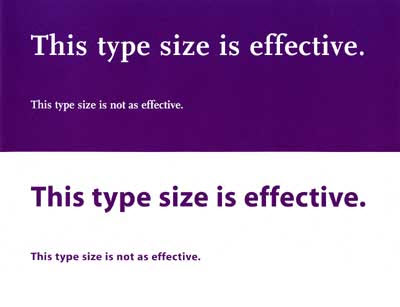
Point Size – The relationship between readability and point size differs somewhat among typefaces. image showing font point size that is effective and point size that is not effective

Leading – Spacing between lines of text, should be at least 25 to 30 percent of the point size. image showing leading that is effective and leading that is not effective

Font Family – Avoid complicated, decorative or cursive fonts. When they must be used, reserve them for emphasis only. image showing times roman font family as a font that is more effective than a decorative font family

Sans-serif or standard serif fonts with familiar, easily recognizable characters are best. image showing difference between serif and san-serif fonts

Font Style – Roman typeface, using upper and lower cases, is more readable than italics, oblique or condensed. image showing font style that is effective and font style that is not effective

Also, you should ensure that your text is selectable. Text that can be selected with a cursor is accessible to screen readers and other assistive technology. Images of text, such as word art, screenshots, or infographics are not accessible. A screen reader can not read the text in images. If you must include non-selectable text, also provide a text alternative.

Some additional points to consider:

  • Color should not be the only method used to convey information
  • Avoid red or green text or text decoration, such as Word Art, Shadows, 3D, etc.
  • Use bold or italic to display emphasis
  • Do not underline text (screen readers interpret underlines as links)
  • Avoid writing whole sentences in capital letters
  • Avoid moving or blinking text
  • Keep the number of fonts used to a minimum
  • The reading order should be the same as the visual order

You can find more information about accessible typefaces and fonts at Web AIM.

You will remove significant barriers for the visually impaired if you take these suggestions into consideration when creating course content. An added bonus is that there will be students without disabilities, as well as those who have chosen not to disclose their disability to you, who will find your use of these tips helpful as well.

A young man with vision impairment is focused on his laptop, working intently.

This is the first in a series of blog posts that is a follow-up to my recent Why Accessibility is Important post where I wrote,

Making accessible content doesn’t have to be complicated... Even small efforts make a big difference. Not only will your materials support students with disabilities, but you’ll also improve the learning experience for everyone. Plus, if you reuse your course content each semester, accessibility updates you make now will continue to pay off in the future.

Brightspace, our Learning Management System (LMS), is designed with accessibility in mind. However, it is the responsibility of the instructor and/or course designer to ensure their course content is formatted using best practices for accessibility; including the use of good heading structure, text formatting, contrast and color, descriptive links, alternative text, tables, lists, etc.

This first post focuses on headings. A good heading structure is an important accessibility consideration. Headings should be used to indicate main points and sub-points on a page. Like an outline, heading levels should appear in logical and consistent order.

Headings allow screen reader users to easily navigate through the page and can make the page more usable for everyone.

Page displaying the text "Chapter 2 Great Design" with identified heading levels for document structure.
A text page showing "Chapter 2 Great Design" with heading levels identified.

When creating documents, many people do not use true "heading styles." For example, when creating a heading, they simply change the font type, enlarge the font size, change the color, make it bold, etc. When this is done, the document has no real structure that can be detected by a screen reader program. While visual learners can scan the page for text that stands out from the rest, users who rely on a screen reader are not able to "see" these elements.

IMPORTANT: When creating heading styles always use the proper heading level. Create uniform headings so that a screen reader can navigate the content and can understand how it is structured. Watch this short video for an explanation of heading structures and reading order.

The correct way to provide structure for accessibility purposes is to use heading styles. Listed below are instructions for applying heading styles in MS Word, PowerPoint, Google Docs, Google Slides, and the Brightspace Editor.

Add heading styles in MS Word document:

  1. Click on the Home tab.
  2. Highlight the text.
  3. Click on the appropriate heading selector in the styles panel (e.g. Heading 1 for top-level heading; Heading 2 for a subheading of the top-level heading, etc.).
image of MS Word ribbon showing headings

Add heading styles in PowerPoint:

Using slide layouts will ensure that files have correctly structured headings and lists, and proper reading order. To assign a Slide Layout:

  1. Click on the Home tab.
  2. Click on New Slide.
  3. Choose the desired layout from the slide options menu.
PowerPoint ribbon showing slide layouts

Add heading styles in Google Docs:

  1. Highlight the text.
  2. Click on the appropriate heading selector in the styles panel (e.g. Heading 1 for top-level heading; Heading 2 for a subheading of the top-level heading, etc.).

Screenshot of Google Docs with the styles panel emphasized for user guidance.

Add heading styles in Google Slides:

Use predefined layouts instead of manually created text boxes, because the layouts are specially coded to work well with adaptive technologies like screen readers. To assign a Slide Layout:

  1. Click on Slide --> Apply layout button.
  2. Choose the desired layout from the slide options menu.

Screenshot of Google Slides with the new layout option emphasized for user guidance.

Add heading styles in the Brightspace Editor:

  1. Highlight the text.
  2. Select the proper heading level from the Format dropdown menu (e.g. Heading 1 for top-level heading; Heading 2 for a subheading of the top-level heading, etc.).

Screenshot of Brightspace Editor with the format option emphasized for user guidance.

Heading structures are essential for organizing documents into logical, hierarchical outlines, which improve readability for all users and ensure accessibility for those using screen readers.

Image credit: "Digital Literacy for visually impaired" by IAPB/VISION 2020 is licensed under CC BY-NC-SA 2.0

Various icons of people on a blue background, emphasizing diversity and the importance of accessibility.

This year marks the 36th anniversary of the Americans with Disabilities Act (ADA), a law ensuring that people with disabilities have the same rights and opportunities as everyone else. In education, accessibility is about more than compliance; it’s about equity and inclusion.

According to a U.S. Government Accountability Office (GAO) report, about 21% of college students report having a disability, including visual, hearing, cognitive, and motor impairments. Many more choose not to disclose their disability and often struggle quietly through their coursework.

Creating Accessible Learning Environments

Accessible course materials give all students a fair opportunity to succeed. Every day, some students encounter barriers such as:

  • Images or videos they cannot see
  • Documents that screen readers cannot interpret
  • Audio they cannot hear
  • Websites or platforms that cannot be navigated without a mouse

Chances are, you already have students in your courses who face these challenges—even if they haven’t disclosed them.

A set of four signs designed to communicate accessibility for people with disabilities.

Upcoming ADA Compliance Requirements

In 2024, the Department of Justice updated Title II of the ADA to require all publicly funded organizations, including colleges and universities, to conform to the Web Content Accessibility Guidelines (WCAG) developed by the World Wide Web Consortium.

  • Most institutions must comply by April 24, 2026.
  • Smaller municipalities and districts (under 50,000 people) have until April 26, 2027.

Non-compliance can result in lawsuits and significant penalties—so now is the time to ensure your materials meet accessibility standards.

While Brightspace is accessible to persons with disabilities, uploaded content may not be. Instructors should make a conscious effort to make sure content is accessible.

How Brightspace Supports Accessibility

Our Brightspace Learning Management System (LMS) is built with accessibility in mind and meets WCAG requirements. However, while the platform itself is accessible, uploaded course content may not be. It’s up to instructors to make sure their materials—documents, media, and links—are accessible to all students.

Practical Steps You Can Take

Making accessible content doesn’t have to be complicated. A few simple practices go a long way:

  • Use clear headings and descriptive hyperlinks
  • Add alternative text (alt text) for all images
  • Provide captions for videos and transcripts for audio
  • Ensure documents (especially PDFs) are screen-reader friendly
  • Avoid using color alone to convey meaning

Even small efforts make a big difference. Not only will your materials support students with disabilities, but you’ll also improve the learning experience for everyone. Plus, if you reuse your course content each semester, accessibility updates you make now will continue to pay off in the future.

In an upcoming series of blog posts, I will go into more detail on the things you can routinely do when you create content and setup your Brightspace courses to make them accessible.

Image credits:
Image by cris renma from Pixabay
HandicappedAccessibleSign by Free SVG is licensed CC0

celebrate GAAD heading with disability icons

Thursday, May 15th, is Global Accessibility Awareness Day (GAAD). GAAD aims to get you talking, thinking, and learning about digital access/inclusion and people with different abilities and talents.

Accessibility is about everyone. It is extremely important for students with disabilities to have access to accessible course content.

Video Notes is a built-in media recording tool in Brightspace that allows instructors and learners to record short videos with a webcam. This makes it easy to personalize the learning experience with short, video-based feedback, comments, or instructions. Video Notes can be added where video attachments are supported and when the Brightspace Editor’s Insert Stuff option is available.

People who are deaf or hard of hearing rely on captions and subtitles to understand video content. But there are a lot of other great reasons for using captions. For example, you may have some learners who choose not to use the sound or they cannot use it without disturbing those around them. You may have some learners who are not native in your language or who have trouble understanding you. Closed captions and subtitles will allow these individuals to receive your message and understand it.

Did you know you can generate automatic closed captions for newly created Video Notes AND you have the ability to manually add or edit closed captions for all previously recorded Video Notes?

Always verify your automatic captions. Automatically generated text often lacks punctuation and struggles with technical jargon, resulting in a "wall of text" that is difficult to follow. Inaccurate captions don't just hinder accessibility; they create a confusing experience for all viewers. Before you share your video, do a quick pass to correct misspellings and add basic sentence structure—it makes a world of difference for viewer comprehension.

Follow these steps to do it.

To generate automatic captions:

  1. Select Add Video Note from the Insert Stuff option in the Brightspace Editor.
  2. Click on New Recording, click Stop Recording when done recording.
  3. Click on Next
  4. Enter a title and description for the Video Note.
  5. Choose the audio language.
  6. Check the "Automatically generate captions from audio" box.
  7. Click Next and follow the prompts.
  8. After video processing, you can view the closed captions using video player controls.
example of automatically generate captions from audio checkbox
Video Notes - automatically generate captions from audio

Note: As with any automatically generated captions, you should verify the accuracy of the automatically generated captions.

To edit/update Video Note captions:

  1. Select Audio/Video Note Editor from the Admin Tools. Admin Tools are accessed from the cog icon in the top right corner of the page.
  2. Locate the Video Note you would like to review the captions for.
  3. Select the Video Note from the list.
  4. Edit the captions in the Captions Editor.
  5. Click on Save Captions.
Admin Tools with Audio/Video Note Editor highlighted
Audio/Video Note Editor
example showing update to automatic captions
Video Notes - update automatic captions

To add Video Note captions:

  1. Select Audio/Video Note Editor from the Admin Tools. Admin Tools are accessed from the cog icon in the top right corner of the page.
  2. Locate the Video Note you would like to add captions to.
  3. Select the Video Note from the list.
  4. Click on the Closed Captions tab.
  5. For automatic captions, select the audio language and then click Auto-Generate OR select Upload to add a captions file.
  6. After video processing, you can view the closed captions using audio/video player controls.
example showing how to generate automatic captions
Video Notes - add captions

Reminder: As with any automatically generated captions, you should verify the accuracy of the automatically generated captions.

Want more information?

Brightspace Tip #299: Video Notes
Create Video Notes
Create and insert a Video Note in Brightspace Editor
Reuse Video Notes
Understanding the Brightspace Editor
Add closed captions to a Video Note
Edit Video Notes closed captions

View current, past, and preview upcoming Continuous Delivery release notes
Instructors Quick Start Tutorial
Brightspace Known Issues
Request a sandbox course
Sign-up for Brightspace training sessions
You can find Brightspace help at D2L's website.
Join the Brightspace Community.
Try these Brightspace How-To documents.
Visit our Brightspace FAQs for additional Brightspace information
or schedule a one-on-one session, email, or
call Janice Florent: (504) 520-7418.

Note: Are you doing something innovative in Brightspace or perhaps you've discovered a handy tip? Share how you are using Brightspace in your teaching and learning in The Orange Room.

Image credit: "celebrate GAAD" by jflorent is dedicated to the public domain under CC0 and is adaption of "disability symbols" by National Park Service in the public domain

celebrate GAAD heading with disability icons

Thursday, May 15th, is Global Accessibility Awareness Day (GAAD). GAAD aims to get you talking, thinking, and learning about digital access/inclusion and people with different abilities and talents.

Accessibility is about everyone. It is extremely important for students with disabilities to have access to accessible course content.

The Brightspace Editor has a built-in accessibility checker that makes it easy to check for issues or offer suggestions to fix identified accessibility issues.

Follow these steps to do it.

To check for accessibility issues:

  1. After you add content to the Brightspace Editor, click the accessibility checker icon.
  2. Brightspace Editor accessibility checker icon

  3. The checker indicates if the content is free of accessibility issues, or offers suggestions to fix them.
  4. accessibility issues detected

Want more information?

Improve Your Course with Brightspace Accessibility Checker
Brightspace Accessibility

View current, past, and preview upcoming Continuous Delivery release notes
Instructors Quick Start Tutorial
Brightspace Known Issues
Request a sandbox course
Sign-up for Brightspace training sessions
You can find Brightspace help at D2L's website.
Join the Brightspace Community.
Try these Brightspace How-To documents.
Visit our Brightspace FAQs for additional Brightspace information
or schedule a one-on-one session, email, or
call Janice Florent: (504) 520-7418.

Note: Are you doing something innovative in Brightspace or perhaps you've discovered a handy tip? Share how you are using Brightspace in your teaching and learning in The Orange Room.

Image credit: "celebrate GAAD" by jflorent is dedicated to the public domain under CC0 and is adaption of "disability symbols" by National Park Service in the public domain

GAAD logo

Thursday, May 15th, is Global Accessibility Awareness Day (GAAD). The purpose of GAAD is to get everyone talking, thinking and learning about digital (web, software, mobile, etc.) access/inclusion and people with different disabilities.

While people may be interested in the topic of making technology accessible and usable by persons with disabilities, the reality is that they often do not know how or where to start. Awareness comes first.

The key to embracing accessibility – whether online, in the classroom, or on campus is realizing that taking the time to address an issue doesn’t just help a handful of individuals; in the end, everyone benefits.

Participants in global accessibility awareness day are encouraged to attempt to go an hour without using a technology most people take for granted – such as not using a computer mouse, attempting to navigate a website using a screen reader, or enlarging all of the fonts in a web browser to 200 percent, to see how functionality may be lost when accessibility isn’t taken into consideration in the design.

Whether you participate in an organized activity with others or not, join in and take an hour out of your day to experience digital accessibility first-hand.

Image credit: "Global Accessibility Awareness Day logo" by Mindymorgan licensed under CC BY-SA 4.0

celebrate GAAD heading with disability icons

Thursday, May 16th, is Global Accessibility Awareness Day (GAAD). GAAD aims to get you talking, thinking, and learning about digital access/inclusion and people with different abilities and talents.

Accessibility is about everyone. It is extremely important for students with disabilities to have access to accessible course content.

Video Notes is a built-in media recording tool in Brightspace that allows instructors and learners to record short videos with a webcam. This makes it easy to personalize the learning experience with short, video-based feedback, comments, or instructions. Video Notes can be added where video attachments are supported and when the Brightspace Editor’s Insert Stuff option is available.

People who are deaf or hard of hearing rely on captions and subtitles to understand video content. But there are a lot of other great reasons for using captions. For example, you may have some learners who choose not to use the sound or they cannot use it without disturbing those around them. You may have some learners who are not native in your language or who have trouble understanding you. Closed captions and subtitles will allow these individuals to receive your message and understand it.

Did you know you can generate automatic closed captions for newly created Video Notes AND you have the ability to manually add or edit closed captions for all previously recorded Video Notes?

Follow these steps to do it.

To generate automatic captions:

  1. Select Add Video Note from the Insert Stuff option in the Brightspace Editor.
  2. Click on New Recording, click Stop Recording when done recording.
  3. Click on Next
  4. Enter a title and description for the Video Note.
  5. Choose the audio language.
  6. Check the "Automatically generate captions from audio" box.
  7. Click Next and follow the prompts.
  8. After video processing, you can view the closed captions using video player controls.
example of automatically generate captions from audio checkbox
Video Notes - automatically generate captions from audio

Note: As with any automatically generated captions, you should verify the accuracy of the automatically generated captions.

To edit/update Video Note captions:

  1. Select Audio/Video Note Editor from the Admin Tools. Admin Tools are accessed from the cog icon in the top right corner of the page.
  2. Locate the Video Note you would like to review the captions for.
  3. Select the Video Note from the list.
  4. Edit the captions in the Captions Editor.
  5. Click on Save Captions.
Admin Tools with Audio/Video Note Editor highlighted
Audio/Video Note Editor
example showing update to automatic captions
Video Notes - update automatic captions

To add Video Note captions:

  1. Select Audio/Video Note Editor from the Admin Tools. Admin Tools are accessed from the cog icon in the top right corner of the page.
  2. Locate the Video Note you would like to add captions to.
  3. Select the Video Note from the list.
  4. Click on the Closed Captions tab.
  5. For automatic captions, select the audio language and then click Auto-Generate OR select Upload to add a captions file.
  6. After video processing, you can view the closed captions using audio/video player controls.
example showing how to generate automatic captions
Video Notes - add captions

Reminder: As with any automatically generated captions, you should verify the accuracy of the automatically generated captions.

Want more information?

Brightspace Tip #299: Video Notes
Create Video Notes
Create and insert a Video Note in Brightspace Editor
Reuse Video Notes
Understanding the Brightspace Editor
Add closed captions to a Video Note
Edit Video Notes closed captions

View current, past, and preview upcoming Continuous Delivery release notes
Instructors Quick Start Tutorial
Brightspace Known Issues
Request a sandbox course
Sign-up for Brightspace training sessions
You can find Brightspace help at D2L's website.
Join the Brightspace Community.
Try these Brightspace How-To documents.
Visit our Brightspace FAQs for additional Brightspace information
or schedule a one-on-one session, email, or
call Janice Florent: (504) 520-7418.

Note: Are you doing something innovative in Brightspace or perhaps you've discovered a handy tip? Share how you are using Brightspace in your teaching and learning in The Orange Room.

Image credit: "celebrate GAAD" by jflorent is dedicated to the public domain under CC0 and is adaption of "disability symbols" by National Park Service in the public domain

celebrate GAAD heading with disability icons

Thursday, May 16th, is Global Accessibility Awareness Day (GAAD). GAAD aims to get you talking, thinking, and learning about digital access/inclusion and people with different abilities and talents.

Accessibility is about everyone. It is extremely important for students with disabilities to have access to accessible course content.

The Brightspace Editor has a built-in accessibility checker that makes it easy to check for issues or offer suggestions to fix identified accessibility issues.

Follow these steps to do it.

To check for accessibility issues:

  1. After you add content to the Brightspace Editor, click the accessibility checker icon.
  2. Brightspace Editor accessibility checker icon

  3. The checker indicates if the content is free of accessibility issues, or offers suggestions to fix them.
  4. accessibility issues detected

Want more information?

Improve Your Course with Brightspace Accessibility Checker
Brightspace Accessibility

View current, past, and preview upcoming Continuous Delivery release notes
Instructors Quick Start Tutorial
Brightspace Known Issues
Request a sandbox course
Sign-up for Brightspace training sessions
You can find Brightspace help at D2L's website.
Join the Brightspace Community.
Try these Brightspace How-To documents.
Visit our Brightspace FAQs for additional Brightspace information
or schedule a one-on-one session, email, or
call Janice Florent: (504) 520-7418.

Note: Are you doing something innovative in Brightspace or perhaps you've discovered a handy tip? Share how you are using Brightspace in your teaching and learning in The Orange Room.

Image credit: "celebrate GAAD" by jflorent is dedicated to the public domain under CC0 and is adaption of "disability symbols" by National Park Service in the public domain

GAAD logo

Thursday, May 16th, is Global Accessibility Awareness Day (GAAD). The purpose of GAAD is to get everyone talking, thinking and learning about digital (web, software, mobile, etc.) access/inclusion and people with different disabilities.

While people may be interested in the topic of making technology accessible and usable by persons with disabilities, the reality is that they often do not know how or where to start. Awareness comes first.

The key to embracing accessibility – whether online, in the classroom, or on campus is realizing that taking the time to address an issue doesn’t just help a handful of individuals; in the end, everyone benefits.

Participants in global accessibility awareness day are encouraged to attempt to go an hour without using a technology most people take for granted – such as not using a computer mouse, attempting to navigate a website using a screen reader, or enlarging all of the fonts in a web browser to 200 percent, to see how functionality may be lost when accessibility isn’t taken into consideration in the design.

Whether you participate in an organized activity with others or not, join in and take an hour out of your day to experience digital accessibility first-hand.

Also, thanks to those of you who attended our "Accessibility Is Not Just for Individuals with Disabilities" workshop. The workshop, the seventeenth in our #LEX Advanced series, helps you to build on the skills you learned in the #LearnEverywhereXULA course and gives you the skills and knowledge you need to create accessible course materials that can benefit everyone. You can find the workshop recording and other resources in support of the workshop on the CAT+FD wiki. Additionally, if you did not get the opportunity to earn a digital badge for participating in the workshop, it's not too late to earn that badge. We have a corresponding “Make It Accessible” module in the #LearnEverywhereXULA (#LEX) course that you can complete to earn a digital badge for this topic. The badge will count towards your #LEX Advanced certification.

Image credit: "Global Accessibility Awareness Day logo" by Mindymorgan licensed under CC BY-SA 4.0