Skip to content

3

by Janice Florent

blind female student listening to screen reader describe information on her computer screen

The fourth tip in my series of accessibility related blog posts will focus on alternative text (alt text). Computers can read text on a screen but images, graphs, and charts are meaningless to visually impaired users. Alt text is an alternate method for supplying information about images to users who are visually impaired.

Alt text is important for screen reader users because a screen reader cannot describe an image. Since screen reader software cannot interpret images, it relies on alt text to communicate image information to the user. When an image does not have alt text the only information the screen reader can relay is that there is an image on the page and provide the file name for the image.

Alt text should describe an image so it makes sense in context. If a picture is worth a thousand words, then a short alt text description may be a poor substitute. While a concise alt text description is important, the alt text should be less than 125 characters. You want to think about what is the most important information you are trying to get across with the image and stay within the 124 or less characters. If the image requires a lengthy description, you should describe the image in the content of the page.

There are several ways to handle complex images (e.g. charts, data, statistics, etc.) where a short description is not possible. The best solution is to include a thorough description of the complex image in the content of the page, immediately before or after the image. If you don't want to add more content to your page, another preferred alternative would be to create another web page with just a description of the complex image and link to it near the image. Additionally, text descriptions of graphs and charts can help all students understand difficult concepts.

How alt text is written will vary depending on the type of image. Most screen reader software announces the presence of an image by appending a word such as "graphic" to the alt text, so using words such as "image" "graphic" and "photo" are unnecessary in the alt text, unless it helps to convey further meaning important for a user to know.

Consider this example which uses “Guide Dog and Man” as the alt text:

example of incorrect use of alt text

The alt text “Guide Dog and Man” is not effective if the intent is to show the dynamic action of guiding in the picture. In this situation a better alt text description is “A guide dog leads the way with her handler holding the guide harness in his left hand” as shown in the following example:

example of correct use of alt text

There is no need to include "image of," "picture of," or "photo of" in the alt text in this example because the screen reader will announce the presence of the image.

Additionally, images that contain text (as in a logo) should generally be coded to just include that text as the alt text.

Many images are used only for visual interest, they aren't meant to convey any meaning or important information. In this case, it is best to use what is called NULL alt text or empty alt text. This is done by entering two quotes ("") with no spaces in between in the alt text box.

So, how can you add alt text to images? Listed below are instructions on adding alt text in MS Word and PowerPoint documents as well as in Blackboard.

Add Alt Text to image in MS Word and PowerPoint 2010:

  1. PC users: right-click on an image
    Mac users: press control key and click on the image
  2. Select Format Picture
  3. Select the option for Alt Text
  4. Type your alt text in the description field
  5. PC users: Click Close
    Mac users: click OK
example of alt text in MS Word and PowerPoint

Add Alt Text to image in Blackboard:

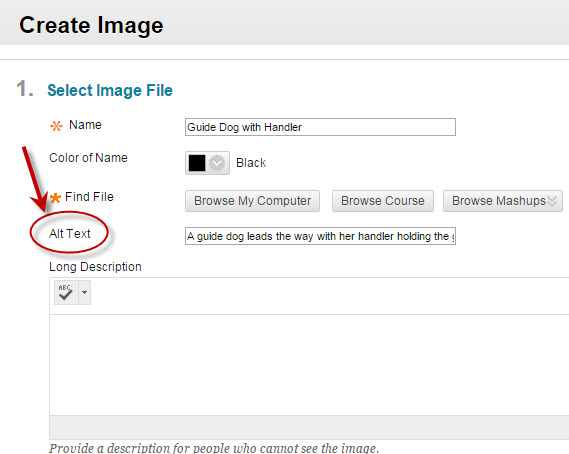
You will find the Alt Text box in various places in Blackboard depending on what and where you are adding the image. Here are some examples:

1. Create Image in Bulid Content:
example of alt text in Content Editor

2. Insert image in the Content Editor:

example of alt text in Content Editor

You will remove significant barriers for the visually impaired if you take these suggestions for adding alt text into consideration when creating course content. An added bonus is that if you take the extra step to include alt text when creating your course content you will be ahead of the game in the event you do have a visually impaired student.

Additional information about alt text can be found at:

Image credit:
"Students of the Educational Institute for the blind show how to use a computer as a learning aid" by Paul Kagame is licensed under CC BY-NC-ND 2.0

by Janice Florent

The third tip in my series of accessibility related blog posts will focus on descriptive links.

Links are like sign posts. They should tell you what you will find when you follow them. When using a computer, people are generally skimming pages for links. They tend to skim pages to quickly find what they are looking for.

Text links on a page are easily identifiable to persons who are not visually impaired because they are normally colored and underlined, and therefore stand out from the other information on the page.

Persons with a visual impairment using screen reader software are presented with a “links list” with all the available links found on the page. Screen reader users and persons using text-to-speech browsers often navigate websites going from link to link using the tab key, so providing descriptive links is extremely important.

Link text stands out in the same way that bold text does. If all your links have non-descriptive link text like "click here" or "more information" users are forced to read the text around the link to understand the context of the link and where it will take them. Therefore "click here" and “more information” are more of a hindrance than a help.

image of non-descriptive link text

For effective skimming, both visual and non-visual users benefit from link text that can stand on its own without the surrounding context of the page. Good link text provides a clear description of the page that will load when following a link. With good descriptive link text, users can skim links and make quick informed decisions about the path to take to accomplish their task. With non-descriptive link text, users cannot ascertain where the link will take them from the link text alone. Therefore, you should avoid non-descriptive link text such as:

  • Click here
  • Here
  • More information
  • Read more
  • Continue

These types of non-descriptive link text offer no explanation and require users to expand their focus to the surrounding context or follow the link to discover its destination.

Consider this example of a list of all the links on a page that a visually impaired user has pulled up for quick access.

image of links list

As you can see, the list of "click here" links is meaningless. Descriptive links as shown in the image below are far more useful.

image of links list

When choosing descriptive links the link text needs to be long enough to convey the purpose of the link and no longer. Make link text clear and self-explanatory to support quick and effective navigation.

image of descriptive link example

When scanning links, the first words in the link text are the ones most likely to grab the user’s attention. Link text that begins with keywords is easier to scan efficiently and works better with software features like "link lists" that visually impaired individuals use to get an alphabetized list of links on a page.

Links beginning with non-descriptive words are not very helpful. Consider these two examples "All about ocean acidification" and "Learn more about global warming." Scanning these links will be slower and the alphabetized links list is not going to be very useful. A better approach is to use only the keywords for link text. For example those two links could be improved if they were formatted as "All about ocean acidification" and "Learn more about global warming."

image of descriptive link example

Some users make links out of entire sentences or entire paragraphs. These long links are probably unnecessary and are not user-friendly for screen reader users. Remember that screen reader users cannot visually scan through lengthy links. They have to listen to the entire text. Some screen reader users get frustrated with long link text and move on to the next link if they cannot understand the purpose of the link after the first few words.

URLs are not always human-readable or screen reader friendly and therefore using URLs as link text should usually be avoided. Exceptions are when the document is intended to be printed or if the URL is relevant content.

In most cases, it is better to use human-readable text instead of the URL. The human-readable link Pocket Guide to Colour Accessibility is more user-friendly than the link to purchase the ebook by the same title on Amazon.com, which consists of this 131-character link full of letters, numbers, slashes, and text that is not very human-readable (http://www.amazon.com/Pocket-Guide-Colour-Accessibility-ebook/dp/B00EPJBN30/ref=sr_1_1?s=digital-text&ie=UTF8&qid=1439306713&sr=1-1.)

Additionally, links don't always lead to web pages. It is equally important to make this clear in your link text. Users appreciate knowing in advance, for example, that if they click on a link on their mobile device they will download a 20Mb PDF. In this case, the link text should indicate that it is a link to a file, including type and size of the file. Here's an example: Getting Started with Assignments (PDF, 20MB).

Writing good link text isn't difficult. If you take these tips for creating descriptive links into consideration when creating course content, you will remove significant barriers for the visually impaired. An added bonus is that there will be students without disabilities, as well as those who have chosen not to disclose their disability to you who will find your use of these tips helpful as well.

If you are interested in getting more information about descriptive links refer to “Link Text” at webaim.org.

1

by Janice Florent

The second tip in my series of accessibility related blog posts will focus on text formatting. Here are a few suggestions for making text legible for persons with a visual impairment and that work for nearly everyone.

Contrast – Use the highest possible contrast for text image showing contrasting text that is effective and text that is not effective

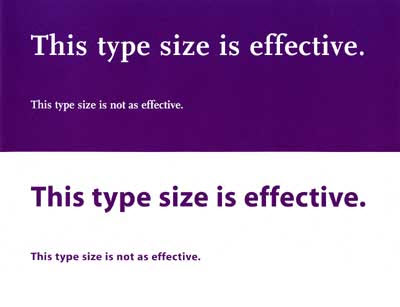
Point Size – The relationship between readability and point size differs somewhat among typefaces. image showing font point size that is effective and point size that is not effective

Leading – Spacing between lines of text, should be at least 25 to 30 percent of the point size. image showing leading that is effective and leading that is not effective

Font Family – Avoid complicated, decorative or cursive fonts. When they must be used, reserve them for emphasis only. image showing leading that is effective and leading that is not effective

Sans-serif or standard serif fonts with familiar, easily recognizable characters are best. image showing difference between serif and san-serif fonts

Font Style – Roman typeface, using upper and lower cases, is more readable than italics, oblique or condensed. image showing font style that is effective and font style that is not effective

Some additional points to consider:

  • Color should not be the only method used to convey information
  • Avoid red or green text or text decoration, such as Word Art, Shadows, 3D, etc.
  • Use bold or italic to display emphasis
  • Do not underline text (screen readers interpret underlines as links)
  • Avoid writing whole sentences in capital letters
  • Avoid moving or blinking text
  • Keep the number of fonts used to a minimum
  • The reading order should be the same as the visual order

You will remove significant barriers for the visually impaired if you take these suggestions into consideration when creating course content. An added bonus is that there will be students without disabilities, as well as those who have chosen not to disclose their disability to you, who will find your use of these tips helpful as well.

If you are interested in getting more information about text formatting refer to "Making Text Legible" at Light House International.

3

by Janice Florent

This is the first in a series of blog posts that is a follow-up to my recent Accessibility in Education post where I wrote,

Even though you may not have a student with a disability currently enrolled in your course, there are a few things you can do when creating content that will save you time later when you do have a student with a disability. This is not wasted time as you will find some students without disabilities will take advantage of accessible content as well.

This post will focus on "Headings." A good heading structure is an important accessibility consideration. Headings should be used to indicate main points and sub-points on a page. Like an outline, heading levels should appear in logical and consistent order.

Headings allow screen reader users to easily navigate through the page and can make the page more usable for everyone.

When creating documents, many people do not use true "heading styles." For example, when creating a heading, they simply change the font type, enlarge the font size, change the color, make it bold, etc. When this is done, the document has no real structure that can be detected by a screen reader program. While visual learners can scan the page for text that stands out from the rest, users who rely on a screen reader are not able to "see" these elements.

The correct way to provide structure for accessibility purposes is to use heading styles. Listed below are instructions on applying heading styles in MS Word, PowerPoint, and the Content Editor.

Add heading styles in MS Word document:

  1. Click on the Home tab.
  2. Highlight the text.
  3. Click on the appropriate heading selector in the styles panel (e.g. Heading 1 for top-level heading).
image of MS Word ribbon showing headings

Add heading styles in PowerPoint:

Using slide layouts will ensure that files have correctly structured headings and lists, and proper reading order.

To assign a Slide Layout:

  1. Click on the Home tab.
  2. Click on New Slide.
  3. Choose the desired layout from the slide options menu.
image of PowerPoint ribbon showing slide layouts

Add heading styles in the Content Editor:

  1. Highlight the text.
  2. Select the proper heading level from the style selector (e.g. Heading for top-level heading; Sub Heading 1 for a subheading of the top-level heading, etc.).
image of Content Editor showing style selector

Note: When creating heading styles always use the proper heading level. Create uniform headings so that a screen reader can navigate the content and can understand how it is structured.

Additionally, you can customize styles.
Learn how to change styles in MS Word 2013
Learn how to change a style set in MS Word 2010
Learn more about PowerPoint 2013 slide layouts
Learn more about PowerPoint 2010 slide layouts

The National Center on Disability and Access to Education developed Accessibility Cheatsheets to assist anyone who is creating accessible content. These free resources are catered to less-technical individuals.

by Bart Everson

I just got back from Meaningful Living and Learning in a Digital World, and I'll be sharing a number of ideas from that conference over the course of the summer.

Always on the lookout for alternatives to Microsoft (shudder) PowerPoint, I was quite intrigued to see the keynote presenter (Tonya V. Thomas) using Slides.

WP_20140319_005

If you haven't heard of it, Slides is a web tool for creating and sharing presentations. Because it uses HTML 5, all you need is a web browser. There's nothing to download or install. It doesn't use Flash. Everything is stored in the cloud, so as long as you have internet access, you'll have access to all your presentations.

Other features of note:

  • Works well with tablets and phones
  • Can be embedded in web pages
  • Exports to PDF
  • Supports mathTeX (for displaying complex equations)

Most interesting to me, you can add slides in both horizontal and vertical directions. Traditional slideshow presentations are one-dimensional (linear) but Slides can be two-dimensional, which opens up some intriguing possibilities.

The free version is pretty good. You can try Slides yourself at Slides.com. In my own tinkering, I've found it very easy to get started. If you'd like CAT to offer a workshop on this topic, leave a comment.

Photo credit: Khedara ආරියරත්න 蒋龙.
For other PowerPoint alternatives, see The Whiteboard Blog.

1

by Janice Florent

Managing, organizing, and citing references can be challenging especially if you don’t keep up with what and who you cite. Two recent articles from the Educational Technology and Mobile Learning web site suggested a few web tools for organizing, managing and publishing bibliographies, citations and references. Those web tools are,

More information about these web tools is available in the "6 of the Best Web Tools for Organizing and Managing Citations, References and Bibliographies" and "A Very Good Tool for Generating Citations, Reference Lists and Bibliographies" articles.

1

by Bart Everson

Embrace Keyboard Shortcuts

Everyone know that I am a hug(e) advocate of keyboard shortcuts. They are easy to learn and will give your productivity a boost. If you really enjoy sitting in front of your computer, and want to spend more time doing that every day while getting less done, then by all means ignore them — but the rest of us will want to memorize our keyboard shortcuts.

Everyone also knows that I do not use PowerPoint, have never used it, and generally avoid Microsoft products as if I was afflicted with a life-threatening allergy.

So that's why you've never heard me talk about keyboard shortcuts for PowerPoint.

Fortunately Scott Schwertly, famed presentation expert, has compiled a list for you. These are keyboard shortcuts you can use when actually presenting with PowerPoint. Extremely handy, if you ever do that. Check it out.

by Janice Florent

Video is a powerful way to make that essential human connection in online courses.

Michelle Pacansky-Brock created this infographic listing six simple tips for recording video as well as a few video recording tools you can use.

The infographic (produced using Piktochart) was originally posted in Michelle Pacansky-Brock’s 6 Tips for Recording Video blog post at Teaching Without Walls.

You can get more information about how to use videos in teaching and learning in these CAT Food blog posts: How to Effectively Use YouTube in eLearning and Bb Tip #108: Videos.

If you are interested in how infographics are being used in education, read this Educause article, 7 Things you Should Know About Infographics.

by Janice Florent

QR (QR being short for Quick Response) codes were first created in 1994 by Toyota to track vehicles in manufacturing using a small barcode that allowed for high-speed component scanning. Although initially used for tracking parts in vehicle manufacturing, QR code technology is experiencing a revival — but not in the automotive industry. The small, square codes are ubiquitous, showing up on everything from billboards and flyers to food packaging.

image of a QR code

QR codes allow people to connect to video, audio, pictures, web sites and more by linking the individual to content on any supported smart phone or with a desktop reader. With the increasing use of mobile technology, QR codes are becoming more common in business and educational settings. The possibilities for their use are endless, and many translate into the classroom, offering a fun and exciting way for students to use technology for learning. If you are interested in how you might utilize QR codes in teaching and learning, read more in this article 50 Great Ways to Use QR Codes in the College Classroom.

Also, here is a link to my Prezi from a past CAT workshop on Educational Uses for QR Codes.

Are you using QR codes? If so, we would like to hear about it. Please feel free to leave a comment telling us how you are using QR codes in your teaching and learning.

by Janice Florent

Did you know that you can add voiceovers (recorded narrations) to PowerPoint presentations? Adding recorded narrations to PowerPoint presentations is a useful feature. Benefits of adding recorded narrations to PowerPoint presentations include:

  • Presentations with voiceovers can be played back by students at their convenience.
  • Students can review the presentation over and over again until they grasp the content.

It’s not difficult to add voiceovers to PowerPoint presentations. Your computer must be equipped with a sound card, microphone, and speakers for you to record and hear the voiceovers.

Kelly Walsh, of EmergingEdTech.com, created this 3-minute Teaching with Tech Tip: Voice Over PowerPoint 2010 video that explains how to do it.

The eLearning Department at Champlain College posted some tips for recording narration into PowerPoint that you may find helpful. Additionally, you can find further explanation on setting and using slide timings at Microsoft's website.

Caution: Adding voiceovers can significantly increase the size of your PowerPoint presentation. If you have a long presentation with a lot of recorded narration, it may take a little while for students to download the file.