Skip to content

the word update written on a chalk board

D2L (the company that owns Brightspace) uses Continuous Delivery to update our Brightspace system. The Continuous Delivery model gives us regular monthly updates allowing for incremental and easily integrated changes with no downtime required for our Brightspace system.

Our Continuous Delivery update occurs on the 4th Thursday of each month. D2L provides release notes to help users stay up-to-date with the changes.

Here are some of the updates in the May 2026/20.26.05 release that were added to our system this month:

1) Assignments – Improved Assignments Submissions layout with accessibility enhancements

D2L refined the Assignments Submissions page by improving the layout in both standard and wide views, reducing the need for horizontal scrolling, and creating a cleaner, more consistent experience. All recent accessibility improvements remain in place.

This change improves the visibility of key information, such as submission dates and learner names, making the page easier to review.

Previously, the page layout with a long file could make it difficult to view key information without scrolling, especially when additional columns, such as Turnitin Similarity Report, were enabled.
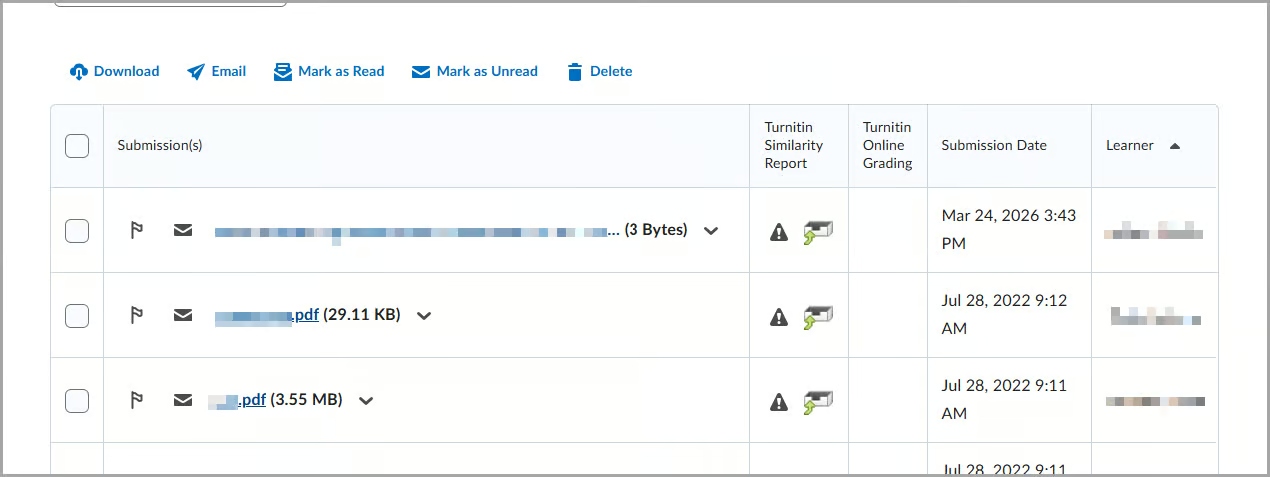
The submissions page after the update showing files, Turnitin report status, submission dates, and learner names, with download, email, and delete actions above.
The assignment submission page after this update.

This feature implements the following PIE item:

  • D13434 (Remove unnecessary scrolling from the Assignment submission page where Turnitin is enabled)

2) Quizzes – Improved Browse Question Library Import button styling and behavior

This update improves the consistency and usability of the Import options in Browse Question Library.

Available import options vary depending on whether the quiz contains sections:

  • The main Import action remains a button for quizzes with no sections.
  • The Import to Section option is now a separate button for quizzes with sections.

This change makes actions more visible and easier to access. Previously, the Import option appeared as a split button with multiple actions in a dropdown.

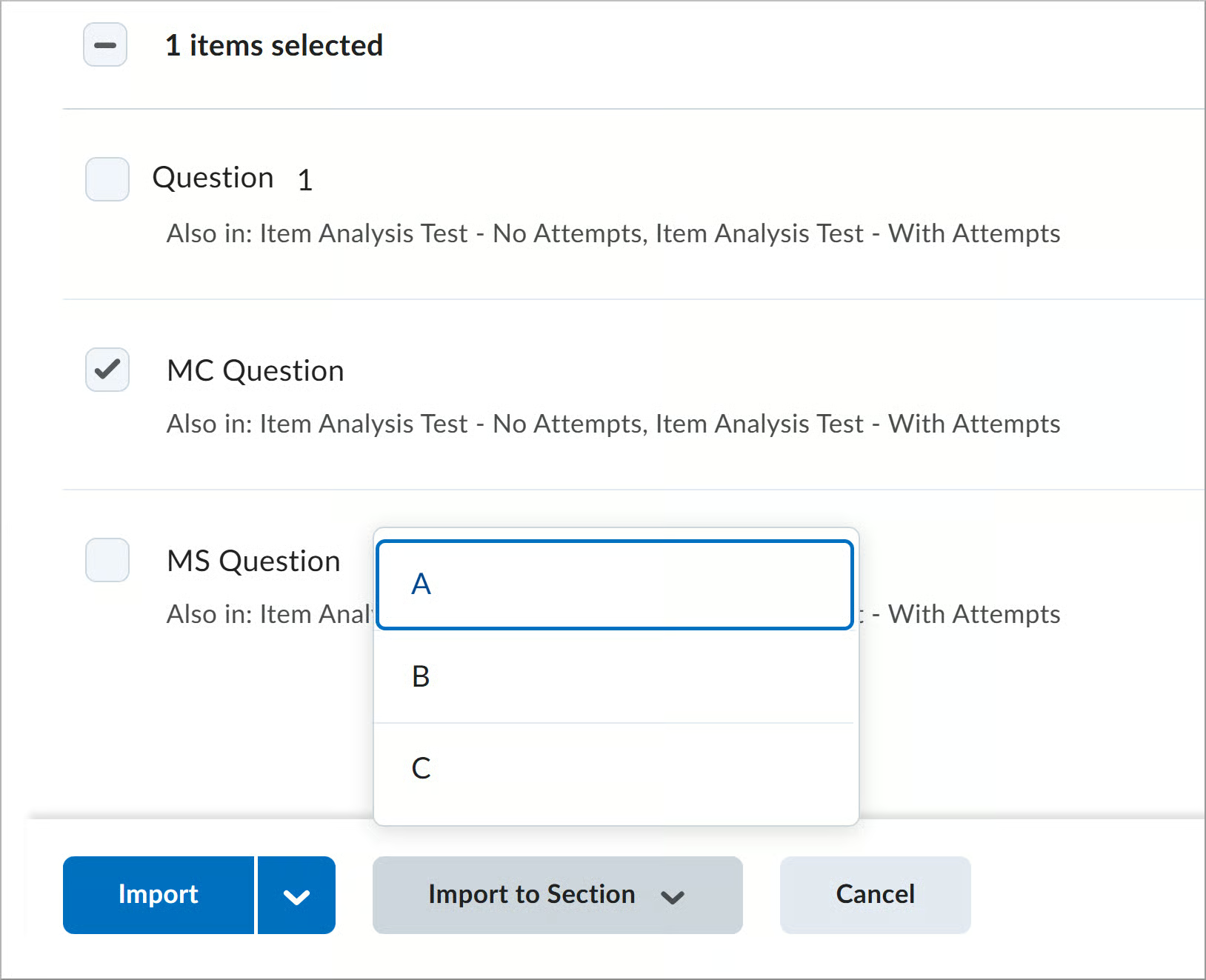
Browse Question Library dialog with one item selected and Import menu expanded showing placement options.
Before state of the Browse Question Library Import dialog, where instructors select questions and use the Import to choose placement in the quiz (top, bottom, or a specific section) from the dropdown.
Browse Question Library dialog shows Import option for placing items at top or bottom of quiz.
New state of the Browse Question Library Import dialog for a quiz with no sections, displaying the import placement options.
Browse Question Library dialog shows Import to Section option for placing items into specific sections.
New state of the Browse Question Library Import dialog, where the Import to Section button allows placement into specific sections.

If you are interested in getting more information about this and all the May Continuous Delivery updates, refer to the Brightspace Platform May 2026/20.26.05 Release Notes.

Additionally, refer to the Brightspace Release Notes for Continuous Delivery Releases, for details about current, past, and to preview upcoming continuous delivery updates.

Want more information?

View current, past, and preview upcoming Continuous Delivery release notes
Instructors Quick Start Tutorial
Brightspace Known Issues
Request a sandbox course
Sign-up for Brightspace training sessions
You can find Brightspace help at D2L's website.
Join the Brightspace Community.
Try these Brightspace How-To documents.
Visit our Brightspace FAQs for additional Brightspace information
or schedule a one-on-one session, email, or
call Janice Florent: (504) 520-7418.

Note: Are you doing something innovative in Brightspace or perhaps you've discovered a handy tip? Share how you are using Brightspace in your teaching and learning in The Orange Room.

Image credit: image by geralt from Pixabay

Underground Kingdom (Choose Your Own Adventure #18) by Edward Packard, published by Bantam Books, 1983.

If you grew up reading Choose Your Own Adventure books like I did, you remember the opening line. Every single book started the same way: You are the hero of this adventure. Not a character the author invented. Not someone you were following from a safe distance. You. The book handed you the story and told you to drive.

Most job postings don't work that way. They're written like traditional novels: the plot is already determined, the role is already defined, and the search process is really just casting — finding the right person to play a part that someone else wrote. There's nothing wrong with that model. It works. It's how CAT+FD has always structured our Faculty-in-Residence positions, but this time around, we decided to try something different.

This time, you write the next chapter.

What's Different

The new Faculty-in-Residence position does not have a predetermined area of focus. That's a significant departure from how this position has worked in the past. Previous FIRs were appointed to support a specific programmatic need that CAT+FD had already identified — New Faculty Support, Service-Learning, Part-time Faculty Support — a focus area we chose in advance and then found the right person to lead.

This appointment inverts that. We are inviting applicants to propose an area of faculty development they are already passionate about, already engaged with, and genuinely well-positioned to support. CAT+FD will then shape the responsibilities of the appointment around the successful candidate's proposal.

What We're Hoping to Hear About

Journey Under the Sea (Choose Your Own Adventure #2) by R.A. Montgomery, published by Bantam Books, 1976.

We're genuinely open on this. The call for applications names a few possible directions — artificial intelligence in teaching and learning, faculty mentoring and peer support, student mentoring and advising as pedagogy, grant writing and management — but those are merely examples. They're areas that have come up in our recent conversations, not a ceiling on what we're willing to consider.

What we're actually looking for is a proposal that identifies a real need in the Xavier faculty community and makes a credible case for why you are the right person to address it. That means thinking seriously about what knowledge or experience you're bringing, what programming might realistically look like given the scope of the position, and who across campus would benefit.

The position is a 12.5% appointment with one course release per year, for a three-year term with the option to renew. It's designed to bring a faculty colleague into the work of CAT+FD in a meaningful, sustained way. The person we appoint will spend a few hours a week in the Center, attend staff meetings and our summer planning retreat, and take the lead on developing and running programming in their proposed area.

Who Should Apply

The Abominable Snowman (Choose Your Own Adventure #13) by R.A. Montgomery, published by Bantam Books, 1982.

The formal requirements are what you'd expect:

  • at least three years of full-time teaching at Xavier;
  • a record of engagement with CAT+FD;
  • evidence of scholarly activity; and
  • a collegial reputation that makes cross-disciplinary collaboration natural rather than forced.

Tenure is preferred, but not required.

But I want to speak past the formal requirements for a moment, because I think the person we're looking for might not immediately see themselves in a list of qualifications.

In Choose Your Own Adventure, the books were always careful to remind you that you weren't just in the story — you were driving it. That required a specific kind of reader: someone curious enough to explore, confident enough to make a choice, and self-aware enough to know something about what kind of adventure they wanted to go on.

That's who I'm hoping applies for this position. Not necessarily the person who has always wanted a faculty development role, but the person who has been quietly doing faculty development work for years without anyone giving it that name; the colleague other people come to when they're trying to figure out how AI is changing their classroom; the one who's been running an informal reading group; the person who thinks deeply about how we mentor graduate students or advise undergraduates through hard moments; the grant writer everyone asks for help and who's never had the support or the platform to do that work at scale.

If any of that sounds like you, we'd like to hear from you.

How You Can Apply

To apply, submit a letter of application that includes a detailed proposal describing your proposed area of focus, along with letters of support from your Department Head or Division Chair and your College Dean. We're accepting applications on a rolling basis throughout the summer, with a final decision before the start of the Fall 2026 semester.

If you have questions before applying, or if you want to talk through an idea before you've fully committed to a direction, reach out. That kind of conversation is part of what this process is supposed to feel like.

There are a lot of possible endings to this story. We're hoping you'll help us write a good one.

Instructors can grant quiz accommodations to learners through the Classlist tool. Instructors can assign accommodations to specific learners that apply across ALL quizzes instead of applying them on a quiz-by-quiz basis. The accommodations option allows the instructor to give the learner more time to complete quizzes at the course level.

A view of the Classlist with the Edit Accommodations option highlighted for a student
The Edit Accommodations option in the Classlist

The Edit Accommodations dialog box with the Modify Time Limit and 1.5 times option selected for a student
The Edit Accommodations dialog box

Once granted, the accommodations apply to all quiz activities in a course for that learner. The additional time can be applied in terms of quiz time multipliers (for example, 1.5 x quiz time) or +minutes (for example, an additional 30 minutes) on every quiz in a course.

Accommodations for Instructors:

  • An icon appears next to the learner’s name in the Classlist to indicate that the learner has an accommodation.
  • Instructors can filter the Classlist by Accommodations.
  • Instructors can also Print or Email a list of users with accommodations by adding the filter to those pages.

Accommodations for learners:

  • An icon appears next to learners’ own names in the Classlist to indicate they have an accommodation. To view accommodation details, learners can click My Accommodations from their learner context menu.
  • When commencing a quiz, the accommodation icon appears next to a learner’s quiz time to indicate that their accommodation has been applied. If a learner’s time accommodation has been overridden by a quiz-specific special access, this icon does not appear.

Example of a Classlist page highlighting the Learner has Accommodations icon
Classlist page highlighting the Learner has Accommodations icon

Example of accommodations reflected in the quiz's time allowed.
Learners can see accommodations reflected in the time allowed when taking quiz

Quiz-specific special access can overwrite an accommodation for any user on a quiz-by-quiz basis. When you overwrite an accommodation and then click Save, a warning describing the impact of overwriting the accommodation appears. Accommodations set for learners in Classlist are displayed in the Special Access for the quiz.

Accommodations indicator in Special Access
An example of how Accommodations set for a learner in Classlist will show up in the Special Access for a quiz

Want more information?

Set Up Brightspace Accommodations by Learner for All Quizzes
Brightspace Tip #584: Quizzes – Special Access
Quizzes FAQ: Hot tips and workarounds
Brightspace Tip #254: Tests and Quizzes
Resources for the Quizzes Tool

View current, past, and preview upcoming Continuous Delivery release notes
Instructors Quick Start Tutorial
Brightspace Known Issues
Request a sandbox course
Sign-up for Brightspace training sessions
You can find Brightspace help at D2L's website.
Join the Brightspace Community.
Try these Brightspace How-To documents.
Visit our Brightspace FAQs for additional Brightspace information
or schedule a one-on-one session, email, or
call Janice Florent: (504) 520-7418.

Note: Are you doing something innovative in Brightspace or perhaps you've discovered a handy tip? Share how you are using Brightspace in your teaching and learning in The Orange Room.

Did you know Special Access is an option available in the Quizzes tool that allows the instructor to grant learners special accommodations?

Special Access allows the instructor to assign specific learners a different set of quiz availability dates, late submission properties, and/or time limits. The instructor can change Start, End, and Due dates; the "Recommended Time Limit" and "Enforced Time Limit" timing settings; and the number of attempts allowed for a quiz to provide allowances for different needs of learners.

Add Special Access in the Quiz Creation Experience

special access options in quizzes
Special Access options in Quizzes

  1. Select Allow selected users special access to this quiz if you want to give certain students different submission options from the rest of the class.
  2. Select Allow only users with special access to see this quiz if only certain students are allowed to see this quiz.
  3. Click Add Users to Special Access to select students who will get the special access.

NOTE: Instructors can exempt individual learners from the requirement to use the Respondus LockDown Browser when taking a quiz. Follow these instructions to add Special Access to quizzes that require Respondus LockDown Browser (RLDB).

Want more information?

Grant Special Access to Users for a Quiz (video)
Set up Availability Dates & Conditions
Add Special Access to quizzes that require Respondus LockDown Browser
Brightspace Tip #585: Quizzes – Set Accommodations by Learner for All Quizzes
Quizzes FAQ: Hot tips and workarounds
Brightspace Tip #254: Tests and Quizzes
Resources for the Quizzes Tool

View current, past, and preview upcoming Continuous Delivery release notes
Instructors Quick Start Tutorial
Brightspace Known Issues
Request a sandbox course
Sign-up for Brightspace training sessions
You can find Brightspace help at D2L's website.
Join the Brightspace Community.
Try these Brightspace How-To documents.
Visit our Brightspace FAQs for additional Brightspace information
or schedule a one-on-one session, email, or
call Janice Florent: (504) 520-7418.

Note: Are you doing something innovative in Brightspace or perhaps you've discovered a handy tip? Share how you are using Brightspace in your teaching and learning in The Orange Room.

A keyboard with an accessibility key, representing accessibility as essential for successful digital transformation.

Although there are legal mandates requiring institutions of higher education to make educational materials accessible (e.g., the Americans with Disabilities Act and Section 504 of the Rehabilitation Act), accessibility is fundamentally just good design. Content that is accessible is better organized and therefore more usable by all. Accessible content renders properly on a wide variety of devices, it is easier to navigate, and it conveys information in a consistent, logical manner. Moreover, changes in how we view the content are occurring. More and more content is being displayed on mobile devices. For content to appear properly on all devices, it must be well designed.

In my recent series of accessibility tips, I identified some things you can do now to design with accessibility in mind as you are creating content and setting up your courses. Designing with accessibility in mind will save you some time in the event you do have a student with a disability. Remember accessible content is not only for the impaired.

Just in case you missed my accessibility series of blog posts, I provided links to them here:

Image credit: "accessibility key" by jflorent is licensed under CC BY 4.0 and is a derivative of "Education Keyboard Button" by GotCredit used under CC BY 2.0

celebrate GAAD heading with disability icons

Thursday, May 21st, is Global Accessibility Awareness Day (GAAD). GAAD aims to get you talking, thinking, and learning about digital access/inclusion and people with different abilities and talents.

Accessibility is about everyone. It is extremely important for students with disabilities to have access to accessible course content.

Video Notes is a built-in media recording tool in Brightspace that allows instructors and learners to record short videos with a webcam. This makes it easy to personalize the learning experience with short, video-based feedback, comments, or instructions. Video Notes can be added where video attachments are supported and when the Brightspace Editor’s Insert Stuff option is available.

People who are deaf or hard of hearing rely on captions and subtitles to understand video content. But there are a lot of other great reasons for using captions. For example, you may have some learners who choose not to use the sound or they cannot use it without disturbing those around them. You may have some learners who are not native in your language or who have trouble understanding you. Closed captions and subtitles will allow these individuals to receive your message and understand it.

Did you know you can generate automatic closed captions for newly created Video Notes AND you have the ability to manually add or edit closed captions for all previously recorded Video Notes?

Always verify your automatic captions. Automatically generated text often lacks punctuation and struggles with technical jargon, resulting in a "wall of text" that is difficult to follow. Inaccurate captions don't just hinder accessibility; they create a confusing experience for all viewers. Before you share your video, do a quick pass to correct misspellings and add basic sentence structure—it makes a world of difference for viewer comprehension.

Follow these steps to do it.

To generate automatic captions:

  1. Select Add Video Note from the Insert Stuff option in the Brightspace Editor.
  2. Click on New Recording, click Stop Recording when done recording.
  3. Click on Next
  4. Enter a title and description for the Video Note.
  5. Choose the audio language.
  6. Check the "Automatically generate captions from audio" box.
  7. Click Next and follow the prompts.
  8. After video processing, you can view the closed captions using video player controls.

example of automatically generate captions from audio checkbox
Video Notes - automatically generate captions from audio

Note: As with any automatically generated captions, you should verify the accuracy of the automatically generated captions.

To edit/update Video Note captions:

  1. Select Audio/Video Note Editor from the Admin Tools. Admin Tools are accessed from the cog icon in the top right corner of the page.
  2. Locate the Video Note you would like to review the captions for.
  3. Select the Video Note from the list.
  4. Edit the captions in the Captions Editor.
  5. Click on Save Captions.

Admin Tools with Audio/Video Note Editor highlighted
Audio/Video Note Editor

example showing update to automatic captions
Video Notes - update automatic captions

To add Video Note captions:

  1. Select Audio/Video Note Editor from the Admin Tools. Admin Tools are accessed from the cog icon in the top right corner of the page.
  2. Locate the Video Note you would like to add captions to.
  3. Select the Video Note from the list.
  4. Click on the Closed Captions tab.
  5. For automatic captions, select the audio language and then click Auto-Generate OR select Upload to add a captions file.
  6. After video processing, you can view the closed captions using audio/video player controls.

example showing how to generate automatic captions
Video Notes - add captions

Reminder: As with any automatically generated captions, you should verify the accuracy of the automatically generated captions.

Want more information?

Brightspace Tip #565: Video Notes
Create Video Notes
Create and insert a Video Note in Brightspace Editor
Reuse Video Notes
Understanding the Brightspace Editor
Edit Video Notes closed captions

View current, past, and preview upcoming Continuous Delivery release notes
Instructors Quick Start Tutorial
Brightspace Known Issues
Request a sandbox course
Sign-up for Brightspace training sessions
You can find Brightspace help at D2L's website.
Join the Brightspace Community.
Try these Brightspace How-To documents.
Visit our Brightspace FAQs for additional Brightspace information
or schedule a one-on-one session, email, or
call Janice Florent: (504) 520-7418.

Note: Are you doing something innovative in Brightspace or perhaps you've discovered a handy tip? Share how you are using Brightspace in your teaching and learning in The Orange Room.

Image credit: "celebrate GAAD" by jflorent is dedicated to the public domain under CC0 and is adaption of "disability symbols" by National Park Service in the public domain

celebrate GAAD heading with disability icons

Thursday, May 21st, is Global Accessibility Awareness Day (GAAD). GAAD aims to get you talking, thinking, and learning about digital access/inclusion and people with different abilities and talents.

Accessibility is about everyone. It is extremely important for students with disabilities to have access to accessible course content. This includes having access to accessible email.

In a series of accessibility related blog posts, I provide suggestions on how you can make small changes to make your materials accessible. This is the eighth tip in my series of accessibility related blog posts and it focuses on email.

Accessible emails ensure that everyone, including people using assistive technologies like screen readers or visual aids, can read and interact with your messages. Many of the same accessibility principles for content creation also apply to email.

Key Accessibility Best Practices

To make sure your emails are fully inclusive, follow these design and formatting rules:

  • Formatting: Break content into short paragraphs and use built-in heading styles (Heading 1, Heading 2) to help users scan your email.
  • Font and Size: Use legible, sans-serif fonts (like Arial, Calibri, or Helvetica) at 12pt or larger. Avoid using italics or complex decorative fonts.
  • Use Color Mindfully: Ensure there is high contrast between your text color and background. Never rely solely on color to convey information.
  • Hyperlinks: Write descriptive link text (e.g., use "Read the Accessible Email Guide" instead of "Click Here").
  • Avoid Tables for Layout: Tables should be avoided when you want to simply format other content (i.e., just to line things up neatly.)
  • Alt Text for Images: Always add descriptive alternative text for any images so screen readers can describe the visuals. Avoid sending "image-only" attachments, as they are unreadable to assistive software.

Send Email Within Brightspace

Email sent within Brightspace is sent using the Email tool. Within the Brightspace Email tool, you will use the Brightspace Editor to compose the body of your email. The Brightspace Editor has a built-in accessibility checker that makes it easy to check for issues or offer suggestions to fix identified accessibility issues.

Email with the Brightspace Editor's accessibility checker icon highlighted.
Email with the Brightspace Editor's Accessibility Checker icon highlighted.

Intelligent Agent email with the Brightspace Editor's accessibility checker icon highlighted with a pop up window showing no accessibility issues detected.
The Brightspace Editor's Accessibility Checker icon is highlighted in this Intelligent Agent's email message with a pop up window showing no accessibility issues detected.

You will remove significant barriers for users of assistive technology if you take these suggestions into consideration when creating email. An added bonus is that if you create your emails with accessibility in mind you will be ahead of the game in the event you do have a student who requires the use of assistive technology.

Want More Information

Email the Entire Class or Individual Students in Brightspace
Creating Accessible Emails
Brightspace Tip #582: Accessibility Checker
Email FAQs

Image credit: "celebrate GAAD" by jflorent is dedicated to the public domain under CC0 and is adaption of "disability symbols" by National Park Service in the public domain

celebrate GAAD heading with disability icons

Thursday, May 21st, is Global Accessibility Awareness Day (GAAD). GAAD aims to get you talking, thinking, and learning about digital access/inclusion and people with different abilities and talents.

Accessibility is about everyone. It is extremely important for students with disabilities to have access to accessible course content.

The Brightspace Editor has a built-in accessibility checker that makes it easy to check for issues or offer suggestions to fix identified accessibility issues.

Follow these steps to do it.

To check for accessibility issues:

  1. After you add content to the Brightspace Editor, click the accessibility checker icon.
  2. Brightspace Editor accessibility checker icon

  3. The checker indicates if the content is free of accessibility issues, or offers suggestions to fix them.
  4. accessibility issues detected

Want more information?

Improve Your Course with Brightspace Accessibility Checker
Brightspace Accessibility

View current, past, and preview upcoming Continuous Delivery release notes
Instructors Quick Start Tutorial
Brightspace Known Issues
Request a sandbox course
Sign-up for Brightspace training sessions
You can find Brightspace help at D2L's website.
Join the Brightspace Community.
Try these Brightspace How-To documents.
Visit our Brightspace FAQs for additional Brightspace information
or schedule a one-on-one session, email, or
call Janice Florent: (504) 520-7418.

Note: Are you doing something innovative in Brightspace or perhaps you've discovered a handy tip? Share how you are using Brightspace in your teaching and learning in The Orange Room.

Image credit: "celebrate GAAD" by jflorent is dedicated to the public domain under CC0 and is adaption of "disability symbols" by National Park Service in the public domain

GAAD logo

Thursday, May 21st, is Global Accessibility Awareness Day (GAAD). The purpose of GAAD is to get everyone talking, thinking and learning about digital (web, software, mobile, etc.) access/inclusion and people with different disabilities.

While people may be interested in the topic of making technology accessible and usable by persons with disabilities, the reality is that they often do not know how or where to start. Awareness comes first.

The key to embracing accessibility – whether online, in the classroom, or on campus is realizing that taking the time to address an issue doesn’t just help a handful of individuals; in the end, everyone benefits.

Participants in global accessibility awareness day are encouraged to attempt to go an hour without using a technology most people take for granted – such as not using a computer mouse, attempting to navigate a website using a screen reader, or enlarging all of the fonts in a web browser to 200 percent, to see how functionality may be lost when accessibility isn’t taken into consideration in the design.

Whether you participate in an organized activity with others or not, join in and take an hour out of your day to experience digital accessibility first-hand.

Image credit: "Global Accessibility Awareness Day logo" by Mindymorgan licensed under CC BY-SA 4.0

A detailed view of a camera shown on a computer screen, focusing on its lens and body.

A new feature of Respondus LockDown Browser / Respondus Monitor is the ability to record the learner from different angles. This feature is aimed at increasing exam integrity by allowing instructors to view a student's workspace, keyboard, and screen, reducing unpermitted resource use.

Respondus Monitor now supports a second camera, providing an additional video angle during exams. This added visibility is designed to deter the use of unapproved resources and give instructors greater control over exam security.

Second camera required prompt as shown during webcam check

This feature allows the use of two cameras for exams using Respondus Monitor: the primary webcam plus a camera from a mobile device (phone, tablet). The second device must be able to scan a QR code. When this setting is enabled by the instructor, the learner will be prompted to set up a second camera.

iPhone screen with a LockDown Browser prompt to position second camera according to instructor's directions and select the "I'm Ready" button to continue.

Post-Exam Review

Once the exam is submitted, the instructor can view up to three videos synchronously with the proctoring results: frontal webcam, second camera, and screen recording.

Respondus Monitor post exam video review

Key Requirements for Students

  • Mobile Device: Students must have a smartphone or tablet with a working camera.
  • Connection: Students will need to scan a QR code displayed on their computer screen during the startup sequence to sync the camera on their mobile device (i.e., the second camera).
  • App/Browser: Students do not need a separate app; when they scan the QR code with their mobile device, it opens a secure web-based recorder in their mobile browser (Safari on iOS 18+ or Chrome on Android).

Want More Information

How to Require a Second Camera for a Respondus Monitor Exam
Setting Up a Second Camera for a Respondus Monitor Exam
Mobile Permissions for Second Camera in Respondus Monitor
Brightspace Tip #200: Respondus LockDown Browser / Respondus Monitor

View current, past, and preview upcoming Continuous Delivery release notes
Instructors Quick Start Tutorial
Brightspace Known Issues
Request a sandbox course
Sign-up for Brightspace training sessions
You can find Brightspace help at D2L's website.
Join the Brightspace Community.
Try these Brightspace How-To documents.
Visit our Brightspace FAQs for additional Brightspace information
or schedule a one-on-one session, email, or
call Janice Florent: (504) 520-7418.

Note: Are you doing something innovative in Brightspace or perhaps you've discovered a handy tip? Share how you are using Brightspace in your teaching and learning in The Orange Room.

Image credit: image by MarcWinter from Pixabay